
By: Julius Konton
Liberia’s renewed push to harness the economic, intellectual, and diplomatic power of its diaspora took center stage in Europe this week as Finance and Development Planning Minister Augustine Kpehe Ngafuan held a high-level engagement with Liberians living across the continent, signaling what officials describe as a decisive shift from symbolic outreach to structured diaspora integration.
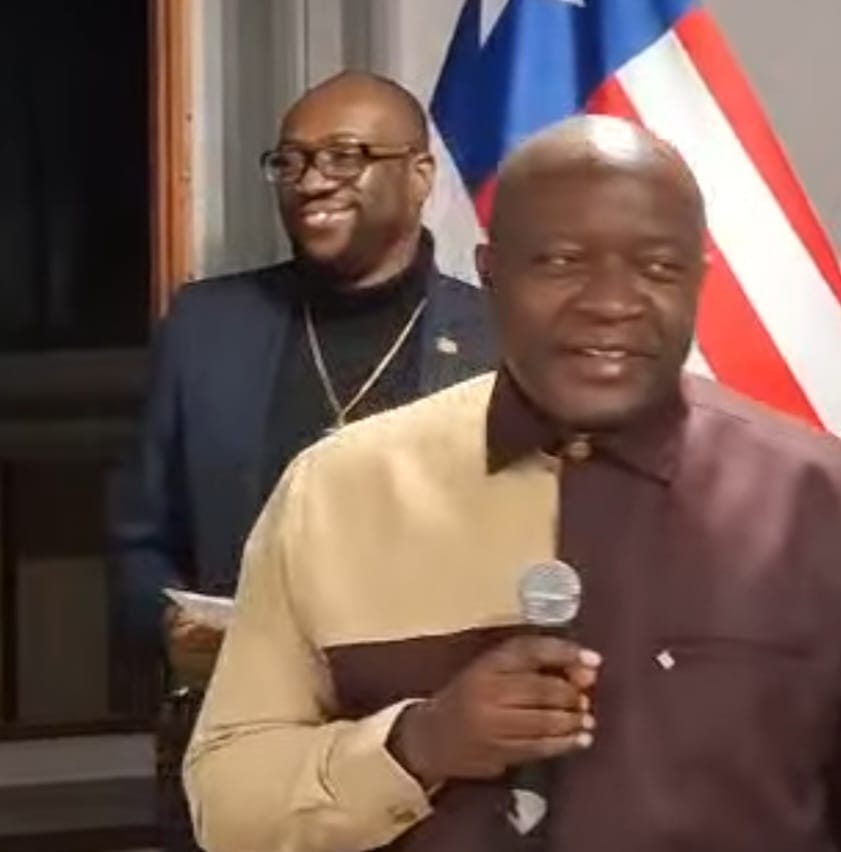
The Diaspora Evening held on the margins of the EU–Liberia Business Forum brought together leaders of Liberian diaspora associations across Europe, senior government officials, ambassadors accredited to European capitals, heads of state-owned enterprises, private sector actors, and representatives of the European Union.
At the heart of the message was a clear political commitment from President Joseph Nyuma Boakai to reposition the diaspora as an essential pillar of Liberia’s national development strategy.
Diaspora Elevated from Stakeholder to Institution
Minister Ngafuan told participants that the Boakai’s administration has already taken concrete steps to institutionalize diaspora engagement beginning with the establishment of a Diaspora Office at the Executive Mansion, now embedded as a permanent line item in the national budget.
“As far as I know, the President wants to scale this up, he wants a full-fledged Diaspora Commission,” Ngafuan disclosed, drawing applause from the audience.
For a country where remittances consistently account for more than 20 percent of GDP, according to World Bank estimates, policymakers acknowledge that Liberia’s economic survival and future growth are inseparable from its citizens abroad.
In 2023 alone, remittance inflows were estimated at over US$700 million, dwarfing foreign direct investment and rivaling official development assistance.
Europe’s Strategic Role in Liberia’s Global Network
The Finance Minister emphasized that Europe occupies a uniquely strategic position within Liberia’s global diaspora architecture.
“Europe is a strong pillar of the Liberian diaspora community. Whatever diaspora agenda or information comes out, Liberians in Europe must play a central role,” Ngafuan stressed.
He assured participants that their concerns including organizational capacity, investment facilitation, and diplomatic representation would be conveyed directly to Monrovia.
From Renting to Ownership: Diplomatic Presence Under Review
Among the most resonant messages from diaspora leaders was a call for Liberia to strengthen its physical and symbolic presence in Europe particularly in Brussels, the headquarters of the European Union.
Ngafuan acknowledged concerns over Liberia operating from rented facilities in key diplomatic hubs and contrasted this with the positive experience of Liberians engaging with missions that own their premises in other European capitals.
“I took note of what you said, and I am confident our colleagues at the Foreign Ministry did as well. We will see what can be done,” he said.
Financial Sector Reforms and the National Payment Switch
Turning to economic reform, Ngafuan highlighted progress in Liberia’s financial architecture, particularly plans to roll out a National Payment Switch, a long-awaited reform aimed at integrating banks, mobile money operators, and government revenue systems.
The initiative, led by the Central Bank of Liberia, is expected to reduce transaction costs, expand financial inclusion, and improve fiscal transparency in a country where more than 60 percent of adults remain outside the formal banking system.
Ngafuan noted that the Central Bank has recorded operational surpluses for two consecutive years, a rare achievement in Liberia’s post-war financial history and a signal of improving macroeconomic discipline.
A Candid Assessment: Progress Amid Persistent Challenges
In a moment of notable candor, the Finance Minister acknowledged that Liberia’s transformation journey remains uneven.
“When you look at Liberia, there are still things that don’t make you comfortable. That’s honesty,” he said.
He used a striking metaphor to describe the depth of the country’s challenges, arguing that Liberia did not start its reform journey at “zero,” but in some sectors, at “negative”, a reference to decades of conflict, institutional decay, and economic collapse.
Yet, he insisted that change is underway.
“The Liberia of today is not the Liberia of yesterday. We still have miles to trek, but progress is real.”
Diaspora as Co-Architects of National Transformation
Ngafuan stressed that development is not the sole responsibility of government, urging diaspora Liberians to see themselves as co-owners of Liberia’s future.
The government, he said, is working closely with development partners particularly United Nations Development Programme on innovative financing mechanisms, including diaspora bonds and other structured investment instruments, though he cautioned that discussions remain at a preliminary stage.
“All I have come to tell you is this: we have heard you.
We are going back, and we will keep in touch.”
High Expectations, Shared Accountability
Addressing Liberian diplomats and officials serving in foreign missions, Ngafuan underscored the weight of public expectation both at home and abroad.
“Liberians are impatient rightfully so. We must deliver.”
He concluded with a personal assurance on behalf of President Boakai:
“The President is humble. We talk, he listens.
And what we can commit to you in the diaspora is that every time you return home, you will see a better Liberia.”
As Liberia recalibrates its development strategy amid fiscal constraints and rising public expectations, the message from Europe is clear: the diaspora is no longer just a source of remittances, it is being positioned as a strategic partner in governance, investment, and national renewal.
