



By: Julius Konton
The International Monetary Fund has praised Liberia for making significant strides in stabilizing its economy and implementing critical fiscal reforms, projecting a stronger economic performance in 2026 as the country continues its recovery and development trajectory.
The IMF, in a statement released Thursday at the conclusion of its latest mission to Monrovia, said Liberia’s economy remains on a “solid path,” underpinned by prudent macroeconomic management, robust domestic revenue collection, and sustained reforms under the Fund’s Extended Credit Facility (ECF).
The IMF staff mission was in Liberia from June 10 to June 23 to conduct the Fourth Review under Liberia’s ECF arrangement and the First Review under the Resilience and Sustainability Facility (RSF), a relatively new IMF financing mechanism designed to help vulnerable economies address climate and structural shocks.
The Washington-based institution projected that Liberia’s real Gross Domestic Product (GDP) will expand by 5.5 percent in 2026, up from an estimated 5.1 percent growth in 2025, signaling a steady upward economic trend.
This growth is expected to be driven largely by increased iron ore production, expansion in the manufacturing sector, and accelerated infrastructure construction.
Liberia’s mining sector remains a cornerstone of its economic performance, accounting for nearly 17 percent of GDP and more than 65 percent of export earnings, according to recent government and IMF estimates.
The country, rich in iron ore, gold, and rubber, has increasingly relied on mineral exports to sustain foreign exchange inflows.
The IMF also highlighted Liberia’s success in containing inflation despite global economic uncertainties and rising fuel prices.
Inflation stood at 5.3 percent in May 2026, a modest increase from 4 percent at the close of 2025, reflecting what the Fund described as “exchange rate stability”.
This marks a notable improvement compared to Liberia’s inflationary shocks in previous years, when consumer prices peaked above 12 percent in 2022 amid global supply disruptions triggered by the Russia-Ukraine war and post-pandemic recovery challenges.
In its assessment, the IMF welcomed the administration of for balancing fiscal discipline with strategic public spending, particularly in health, education, and social protection for vulnerable communities.
The Fund noted that Liberia’s fiscal performance remains aligned with agreed targets, bolstered by stronger-than-expected domestic revenue generation and a one-time US$200 million bonus payment, representing approximately 3.5 percent of GDP, a significant fiscal injection expected to support public investments.
Liberia’s national budget for Fiscal Year 2026 currently stands at approximately US$1.294 billion, the largest in the country’s history, reflecting the government’s push under the ARREST Agenda for Inclusive Development (AAID), which prioritizes agriculture, roads, rule of law, education, sanitation, and tourism.
However, the IMF warned that Liberia’s current account deficit could widen in 2026 due to increased importation of fuel, heavy machinery, and industrial inputs linked to mining expansion and large-scale infrastructure works.
Despite these challenges, the Fund maintained that Liberia’s medium-term economic outlook remains positive, provided reforms continue and global commodity prices remain favorable.
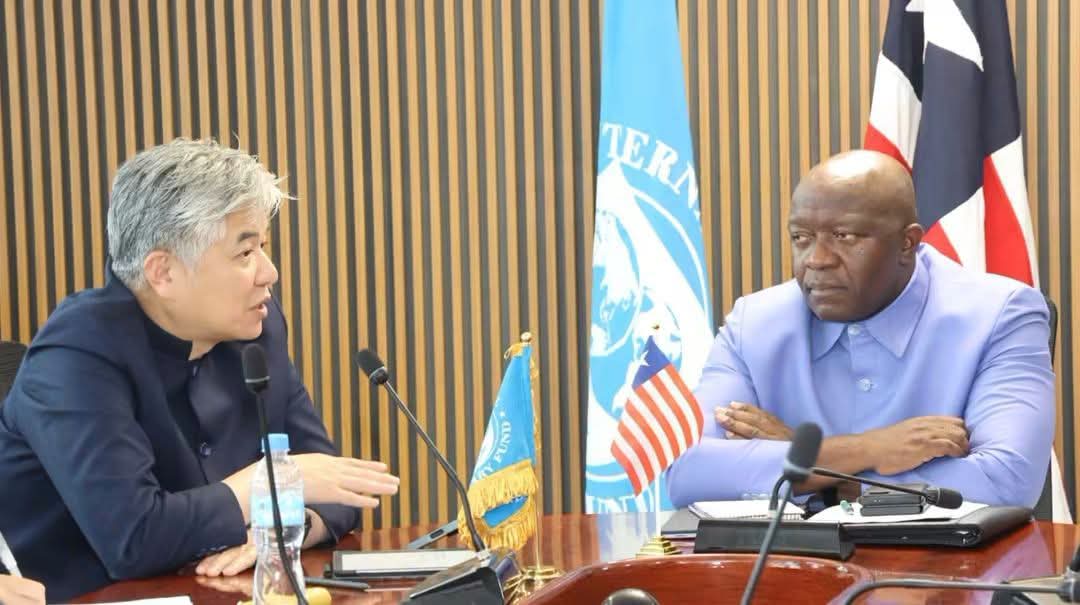
“Discussions with the Liberian authorities were constructive, and we reached broad understanding on the policies underpinning the fourth review of the ECF-supported program,” Mr. Kim noted.
During the mission, the IMF delegation held consultations with President Boakai, Finance and Development Planning Minister , Executive Governor of the Central Bank , senior policymakers, and development partners.
Liberia entered the current IMF-backed reform program in 2024 as part of efforts to restore fiscal confidence, strengthen debt sustainability, and improve governance following years of economic vulnerability.
Since then, the government has undertaken reforms in tax administration, expenditure controls, and public financial management.
Economic analysts say the IMF’s positive assessment could boost investor confidence and strengthen Liberia’s position in attracting foreign direct investment, especially in mining, agriculture, and infrastructure.
For a country still rebuilding from the scars of civil conflict, Ebola, and the COVID-19 pandemic, the IMF’s endorsement signals growing confidence that Liberia may be entering a more stable and transformative economic era.


