


By: Julius Konton
Denmark has voiced strong support for Morocco’s autonomy proposal for the Sahara, describing the initiative as a credible and constructive basis for reaching a mutually acceptable political settlement to the long-running Western Sahara dispute.
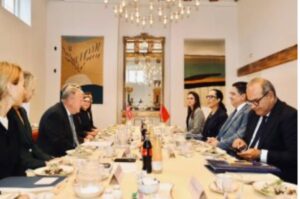
The position was expressed by Danish Foreign Minister Lars Løkke Rasmussen during high-level talks in Copenhagen with Morocco’s Minister of Foreign Affairs, African Cooperation and Moroccan Expatriates, Nasser Bourita.
Rasmussen said Denmark welcomed the latest United Nations Security Council approach to the Western Sahara question, referring specifically to Resolution 2797, adopted on October 31, 2025.
“Denmark lauds, in line with the European Union’s position, the adoption of UNSC Resolution 2797,” Rasmussen said in remarks to the press.
The Danish foreign minister also described Morocco’s autonomy proposal as “credible,” arguing that it represents a serious and essential contribution to the UN-led political process.
According to Rasmussen, the proposal provides a “good basis for a mutually agreed solution by all parties,” signaling Copenhagen’s growing emphasis on compromise and negotiated settlement rather than further prolongation of the decades-old dispute.
Western Sahara, a sparsely populated territory of approximately 266,000 square kilometers and an estimated population of about 612,000, has remained on the United Nations list of Non-Self-Governing Territories since 1963.
The modern conflict intensified after Spain ended its colonial presence in the territory in 1976. Morocco and the Polisario Front subsequently became the principal parties to the dispute, while Mauritania, which had also claimed part of the territory, renounced its claim in 1979.
Following years of armed conflict, Morocco and the Polisario Front agreed to a UN-backed ceasefire that took effect on September 6, 1991.
The United Nations established the United Nations Mission for the Referendum in Western Sahara (MINURSO) in April 1991 to monitor the ceasefire and support implementation of the settlement process.
The referendum envisaged under the original UN settlement plan, however, was never held, largely because the parties remained divided over voter eligibility and the political framework for resolving the dispute.
Morocco formally presented its Initiative for Negotiating an Autonomy Statute for the Sahara Region to the United Nations in April 2007.
The proposal subsequently became an important element of international discussions concerning the territory.
In Security Council Resolution 1754 of 2007, the UN Security Council took note of Morocco’s proposal and called on the parties to engage in negotiations without preconditions and in good faith toward a “just, lasting and mutually acceptable political solution.”
The latest diplomatic developments have further elevated the autonomy proposal in international discussions.
Resolution 2797, adopted unanimously by the Security Council on October 31, 2025, reaffirmed support for a political process aimed at achieving a just, lasting and mutually acceptable solution based on compromise and consistent with the UN Charter, including the principle of self-determination.
At the same time, UN documentation makes clear that the resolution does not eliminate the broader requirement for negotiations or foreclose other proposals.
The objective remains a final political settlement acceptable to the parties.
Denmark’s Position and European Diplomacy
Denmark’s latest declaration places Copenhagen among the European voices giving greater diplomatic weight to Morocco’s autonomy initiative while continuing to frame the issue within the UN political process.
As a member of the UN Security Council, Denmark’s position carries additional diplomatic significance.
Copenhagen’s endorsement could contribute to wider European engagement on a dispute that has remained unresolved for more than five decades.
For Morocco, the Danish statement represents another diplomatic boost to its longstanding position that autonomy under Moroccan sovereignty offers a realistic framework for resolving the dispute.
Rabat has increasingly promoted the autonomy proposal as the basis for a political settlement, while maintaining that the solution should be negotiated under United Nations auspices.
The Polisario Front, meanwhile, continues to advocate self-determination for the Sahrawi people and has historically supported independence as one possible outcome.
The Western Sahara dispute has endured through multiple rounds of negotiations, ceasefire arrangements and UN-led initiatives.
MINURSO remains deployed more than three decades after its creation, continuing its peacekeeping and monitoring role despite the breakdown of the 1991 ceasefire in 2020.
Denmark’s latest intervention therefore comes against the backdrop of renewed international efforts to move the political process beyond decades of stalemate.
For Copenhagen, supporting Morocco’s autonomy proposal while emphasizing a negotiated and mutually acceptable settlement reflects an attempt to reconcile Morocco’s proposal with the broader UN framework.
For Rabat, the statement reinforces what Moroccan officials describe as growing international momentum behind the autonomy initiative and Morocco’s position on the Sahara.
The diplomatic challenge now is whether this expanding international support can translate into meaningful negotiations capable of producing a settlement acceptable to Morocco, the Polisario Front and the other stakeholders involved in the UN process.
With the United Nations continuing to facilitate negotiations, Denmark’s declaration adds another European voice to an increasingly active international debate over how to bring one of Africa’s longest-running territorial disputes to a durable political conclusion.


