


By: Julius Konton
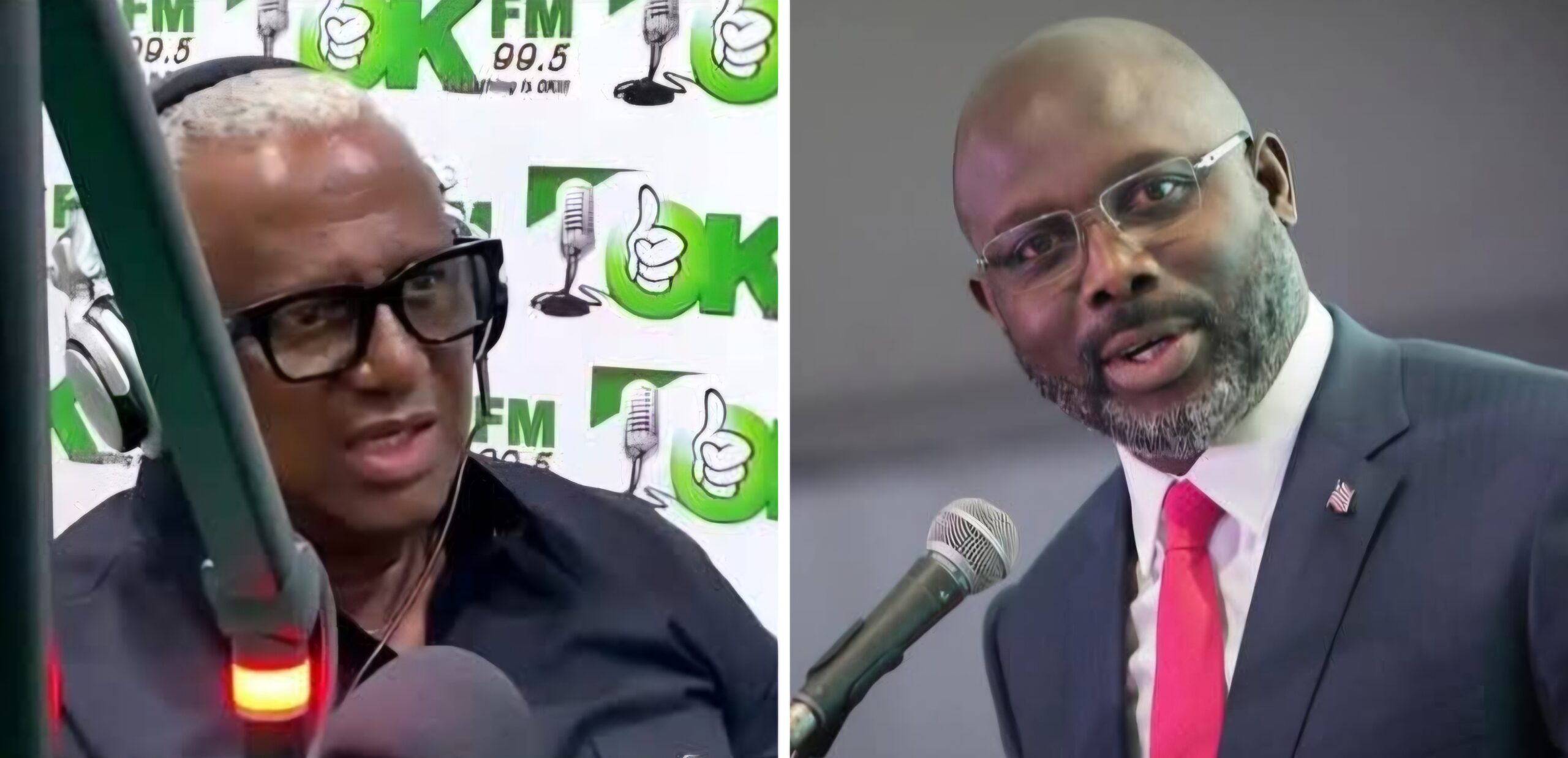
In a moment that blended diplomacy, admiration, and sharp political critique, visiting Guinean-Bissauan politician and ECOWAS Parliamentarian Manuel Irenio Nascimento has described former Liberian President George Manneh Weah as a “ten-star gentleman” and a living African legend whose legacy, he said, deserves protection by the continent.
Speaking on Liberia’s OK Conversation Show, Nascimento urged Africans to move beyond the tradition of celebrating leaders only after their deaths and instead safeguard those he described as “living symbols of hope, values, and resilience.”
“I don’t consider George Weah a five-star gentleman,” Nascimento declared. “He is a ten-star gentleman, a man of values, humility, and history.
Africa must learn to protect its living legends”, he re-emphasized.
From Football Icon to Continental Symbol
George Weah’s stature transcends Liberia’s borders. As Africa’s only Ballon d’Or winner (1995) and a former FIFA World Player of the Year, Weah became a global sporting icon before entering politics.
His election as Liberia’s president in 2017, nearly 14 years after the end of a brutal civil war that killed an estimated 250,000 people, marked a symbolic shift in African leadership, one rooted in popular appeal rather than elite political lineage.
Nascimento revealed that he met Weah at a FIFA Congress in Zurich, Switzerland, alongside Liberia’s Bomi County Senator Edwin Melvin Snowe Jr., further cementing a relationship born out of shared interests in football governance and regional cooperation.
A former football administrator himself in Guinea-Bissau, Nascimento said Weah’s journey resonates deeply across West Africa, where football remains both a cultural unifier and a pathway out of poverty for millions of young people.
Liberia’s Peace as a Regional Model
The ECOWAS lawmaker commended Liberia for sustaining over a decade of uninterrupted peace, a rare achievement in a region frequently rocked by coups, electoral disputes, and insurgencies.
Since the end of Liberia’s civil conflict in 2003, the country has experienced multiple peaceful transfers of power most recently the 2023 elections, reinforcing its democratic credentials in a region where, between 2020 and 2024, at least eight coup attempts occurred across West Africa.
“Liberia is an example for West Africa,” Nascimento said. “Your people are humble, peaceful, and united.
This unity has preserved peace for more than ten years and that is not accidental.”
He added that Liberia’s stability stands in sharp contrast to political volatility in several neighboring states, including his own country, Guinea-Bissau, which has endured at least nine coups or attempted coups since independence in 1974.
Historic Ties Between Liberia and Guinea-Bissau
Nascimento traced the historical relationship between both nations, recalling that former Liberian President William R. Tolbert Jr. was the first foreign leader to visit Guinea-Bissau following its initial democratic elections, an early gesture of Pan-African solidarity that, he said, should not be forgotten.
As a two-year-serving member of the ECOWAS Parliament, Nascimento emphasized that such historical bonds should guide modern West African diplomacy, especially at a time when regional unity is under strain.
Praise for Liberian Leaders and Diplomats
The Guinean-Bissauan lawmaker extended commendation to several Liberian officials, including Senator Edwin Melvin Snowe Jr., whom he described as “firm, loyal, and principled not only for Liberia, but for West Africa.”
He also praised Liberia’s Ambassador to Nigeria, John Ballout, calling him “a fantastic gentleman” whose diplomatic work reflects Liberia’s renewed engagement in regional affairs.
Nascimento is currently in Liberia at the invitation of Senator Snowe and disclosed longstanding ties with Musa Hassan Bility, former Liberia Football Association (LFA) president and now Nimba County District Seven Representative.
A Stark Warning on Democracy and Electoral Manipulation
Beyond praise, Nascimento delivered a blunt warning to West African leaders, calling on them to respect election results and end what he described as systematic manipulation of democratic processes.
“If we continue this way, democracy in West Africa will die,” he warned.
He alleged that the political crisis in Guinea-Bissau stemmed from what he termed an “invented coup” and accused the country’s embattled leadership of fueling tribal divisions that historically never existed.
In a direct rebuke of regional institutions, Nascimento criticized the ECOWAS Commission for what he called its failure to uphold election results validated by international observers, including the ECOWAS Parliament itself.
“ECOWAS must defend the interests of West Africans not individuals,” he insisted.
Double Standards and Regional Integrity
Nascimento compared Guinea-Bissau’s prolonged crisis to a similar political upheaval in Benin, which he noted was resolved within 72 hours, questioning why his country continues to face international paralysis.
“The difference between Guinea-Bissau and Benin is just the letters ‘G’ and ‘B,’” he remarked. “We must be fair.”
He disclosed that his outspoken stance has made it unsafe for him to return home, underscoring the risks faced by reform-minded politicians in fragile democracies.
Women, Youth, and the Cost of Corruption
The ECOWAS lawmaker placed particular emphasis on the socio-economic burden borne by women, noting that across West Africa, a majority of informal street traders are women, many of whom lack social protection or access to capital.
“We use women when we need them and abandon them afterward. That is killing the civilization of West Africa,” he said.
Nascimento described corruption as “one of the most destructive viruses” in the region, citing Transparency International data showing that over two-thirds of West African countries score below the global average on corruption perception indexes.
He urged leaders to govern for the people rather than family networks, warning that misrule threatens the future of Africa’s youth nearly 60% of the continent’s population.
A Call for Leadership, Legacy, and Responsibility
In closing, Nascimento called on African leaders to step aside when they are no longer capable of delivering results.
“If we are not entitled to occupy a seat, let us leave it for more competent people.
Otherwise, instead of developing, we will retreat and our young generations will pay the price.”
As his remarks reverberated across Liberia’s political and media space, one message stood out clearly: in praising George Weah as a ten-star gentleman, Nascimento was not merely honoring a former president, but issuing a broader appeal for ethical leadership, democratic integrity, and the preservation of Africa’s living legacies.


