
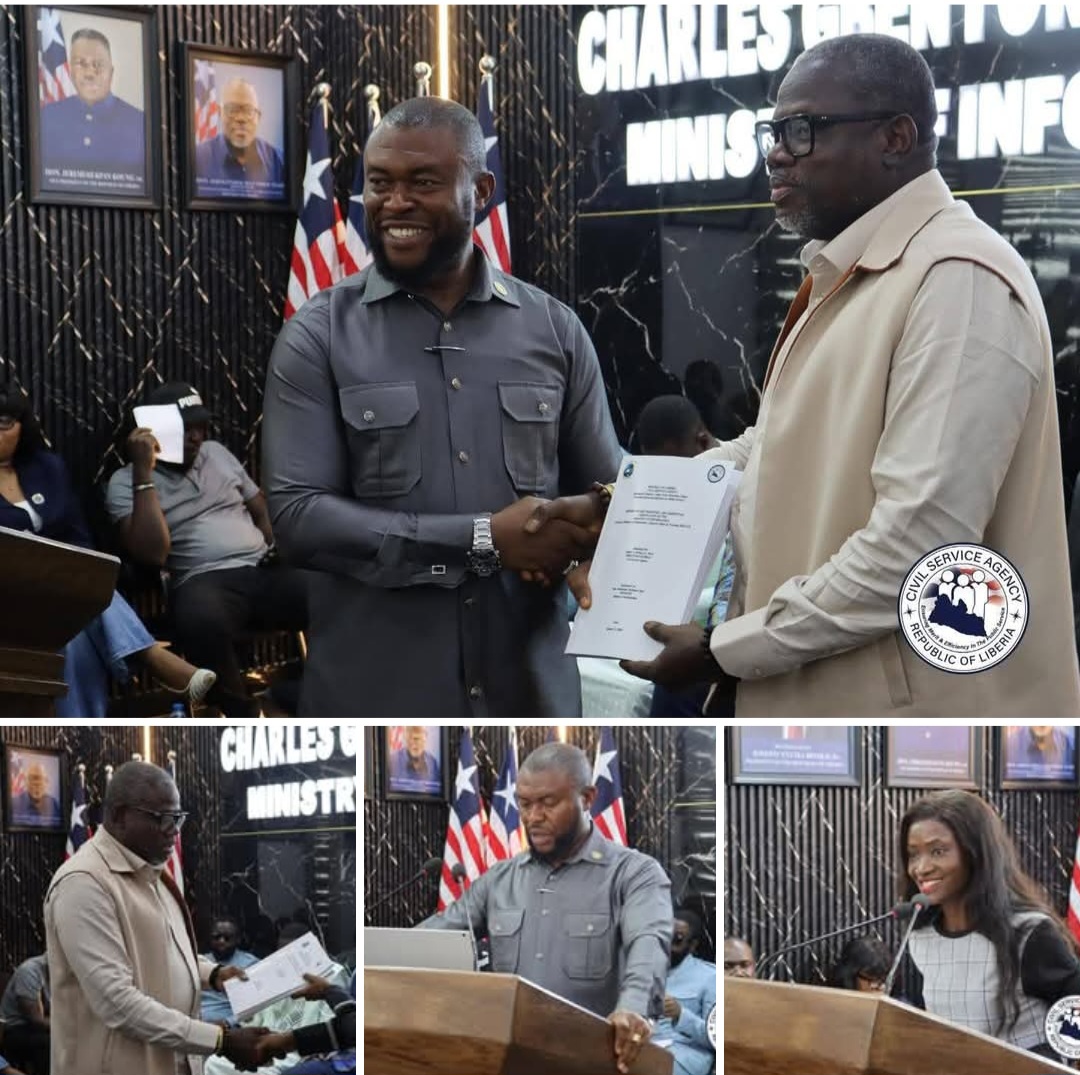
By: Julius Konton
Liberia has taken another major step toward strengthening public sector accountability and institutional efficiency, following the completion of a comprehensive civil service verification exercise covering the Ministry of Information, Cultural Affairs and Tourism (MICAT) and the newly established Liberia National Tourism Authority (LNTA).
The findings, officially presented by the Civil Service Agency (CSA), Director General Dr. Josiah F. Joekai Jr. confirm a verified workforce, expose skills and placement gaps, and mark a critical milestone in Liberia’s long-running post-conflict civil service reform agenda aimed at eliminating ghost workers, improving payroll integrity, and professionalizing state institutions.
The verification exercise was led by CSA Director General Dr. Josiah F. Joekai, alongside a multidisciplinary team of human resource, payroll, and forensic credential specialists.
Why the Verification Matters
Liberia’s civil service reform drive dates back to the post-war reconstruction era, when weak payroll controls, undocumented appointments, and skills mismatches undermined service delivery and drained public finances.
Over the past decade, successive administrations have intensified efforts to clean up government payrolls, enforce merit-based recruitment, and align staff qualifications with job roles.
The creation of the Liberia National Tourism Authority, carved out of MICAT’s former Culture and Tourism Department, represents a strategic shift to professionalize tourism governance and diversify Liberia’s economy beyond extractive industries.
To ensure credibility and continuity, the CSA undertook a data-driven verification to clearly distinguish staff remaining at Ministry of information from those transitioning to the LNTA.
“This was not a bulk transfer,” Dr. Joekai stressed. “It was a deliberate, evidence-based process to establish who is qualified, who is active, and where each employee properly belongs.”
Key Findings at the Ministry of Information
Out of 287 sampled employees, the CSA conducted:
Physical headcounts
Attendance and payroll audits
Forensic credential scanning
Personnel file reviews
Job-to-qualification alignment assessments
Verification Outcome shows
255 employees (88.8%) physically appeared and were fully verified
10 employees (3.4%) were unverifiable after failing to appear
15 employees (5.2%) were excused due to documented leave or outstation assignments
7 employees (2.4%) were presidential appointees and assessed separately
Personnel File Integrity Gaps Exposed
The CSA uncovered widespread documentation deficiencies, including missing:
Appointment letters
Job descriptions
Academic and professional credentials
National identification documents
Payroll and banking records
“Through collaboration with MICAT’s Human Resource Department, all verified personnel files were standardized to meet national civil service compliance requirements”, he told the gathering.
Attendance and Payroll Integrity
The audit revealed:
226 employees actively reporting with no attendance violations
29 employees flagged for absenteeism
Disciplinary actions recommended under Civil Service Standing Orders include:
19 salary deductions (3–6 days absence)
4 suspensions without pay (7–13 days absence)
6 dismissals (14 days or more absence)
Educational and Skills Profile
Among the 255 verified MICAT employees:
Master’s degrees: 13
Bachelor’s degrees: 103
Associate degrees: 12
Professional certificates/diplomas: 48
High school diplomas only: 51
No academic or professional credentials: 27
The CSA warned that 78 staff members with only high school education or no credentials represent a significant skills gap, potentially limiting institutional productivity and modernization.
Job Placement and Gender Balance
Correctly placed: 185 staff (72.5%)
Overqualified: 28 staff
Underqualified: 18 staff
Completely misplaced: 25 staff
He was quick to add that all 71 affected employees were recommended for reclassification or redeployment.
Gender distribution at Information Ministry
Male: 158 (62%)
Female: 97 (38%)
The CSA noted a gender imbalance and urged targeted equity-focused workforce planning.
Retirement and Transition Measures
He said five employees at retirement age will transition to the National Social Security and Welfare Corporation (NASSCORP) while
Exceptional short-term extensions may be granted based on health status and institutional relevance
At the Liberia National Tourism Authority (LNTA): Transition Results for the 100 employees transitioning to LNTA shows that 89 employees (89%) physically verified
9 employees (9%) unverifiable
2 employees (2%) presidential appointees
Attendance
85 employees (96%) with satisfactory attendance
4 employees (4%) flagged for salary deductions
No cases met suspension or dismissal thresholds
Educational Profile at LNTA
Among the 89 verified LNTA staff:
Master’s degrees: 2 (2%)
Bachelor’s degrees: 29 (32.5%)
Associate degrees: 1 (1.2%)
Professional certificates/diplomas: 12 (13.4%)
High school diplomas: 24 (26.9%)
No credentials: 21 (23.6%)
Only 54 employees (60.7%) possess verifiable academic or professional qualifications, highlighting the need for targeted capacity-building.
Forensic Credential Verification
Dr. Joekai emphasized that Liberia’s credential verification process is forensic rather than punitive, involving third-party authentication from issuing institutions.
“If a credential cannot be scanned, it is not automatically fraudulent.
It is referred to the issuing institution for confirmation,” he explained.
Similar audits have already been conducted at the Judiciary, Monrovia City Corporation, Ministry of Agriculture, and the National Bureau of Concessions, he added.
At LNTA:
14 employees (15.7%) had credentials flagged as suspended or unverifiable and will undergo administrative review.
Job Matching and Gender Balance at LNTA
Properly placed: 77 employees
Require reclassification/redeployment: 12 employees
Gender distribution:
Male: 45 (51%)
Female: 44 (49%)
The CSA praised LNTA’s near gender parity as a strong foundation for inclusive leadership and governance.
Strategic Implications for Reform
According to the CSA, the verification exercise has:
Strengthened payroll integrity
Corrected personnel documentation gaps
Exposed skills shortages and placement mismatches
Provided a reliable, data-driven workforce profile with over 76% of LNTA staff below retirement age, the Authority is well-positioned for succession planning and long-term capacity development.
Dr. Joekai described the exercise as a cornerstone of Liberia’s public sector reform agenda.
“Sustained political commitment, digital HR modernization, and strict policy enforcement are essential to institutionalize these gains and deliver efficient public services,” he concluded.
