



By: Julius Konton
The European Union has taken a significant diplomatic step toward resolving the decades-long Western Sahara dispute, formally endorsing autonomy under Moroccan sovereignty as one of the most viable solutions to the conflict.
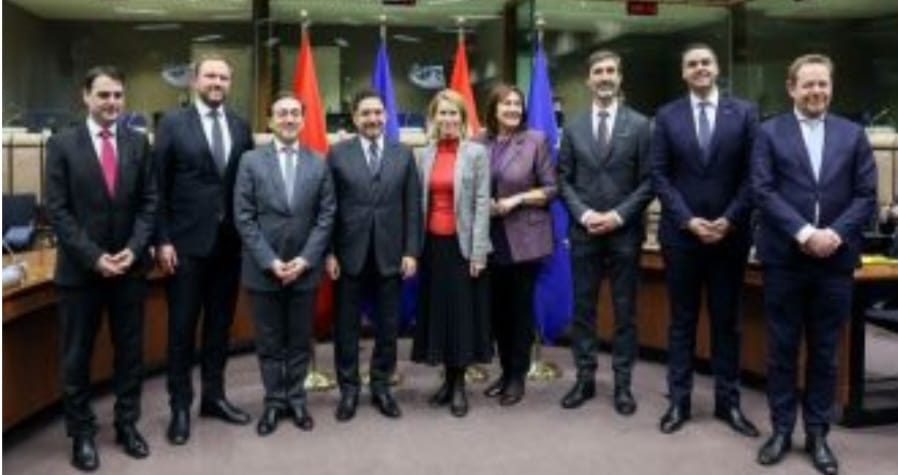
The position was adopted during the 15th session of the EU–Morocco Association Council, in Brussels.
The new stance was enshrined in a joint communiqué signed by Morocco’s Minister of Foreign Affairs, African Cooperation and Moroccan Expatriates, Nasser Bourita, and the EU’s High Representative for Foreign Affairs and Security Policy, Kaja Kallas, marking a rare unified position among the 27 EU member states on one of North Africa’s most sensitive geopolitical issues.
A Shift Toward Pragmatism
In the communiqué, the EU explicitly acknowledged that “genuine autonomy could be among the most feasible solutions” for reaching a final settlement of the Moroccan Sahara question.
This language represents a notable evolution from the EU’s traditionally cautious neutrality and aligns Brussels more closely with Rabat’s long-standing diplomatic position.
The EU further reiterated the call made by the United Nations Security Council, urging all parties involved to engage in negotiations “without preconditions” and “on the basis of the autonomy plan proposed by Morocco.”
The bloc also praised Morocco’s readiness to provide greater clarity on how autonomy would function within the framework of Moroccan sovereignty, a key demand from international partners seeking concrete governance guarantees.
Backed by the United Nations
The European position comes on the heels of the adoption of UN Security Council Resolution 2797 (2025), passed on October 31, 2025, which reaffirmed support for the UN Secretary-General’s efforts and his Personal Envoy to facilitate negotiations grounded in Morocco’s autonomy initiative.
Resolution 2797, adopted by a strong majority of the Council’s 15 members, reflects a growing international consensus that autonomy represents a realistic and sustainable pathway, as opposed to stalled referendum-based approaches that have dominated discussions since the 1991 ceasefire.
Decades-Long Dispute
The Western Sahara issue dates back to 1975, following Spain’s withdrawal from the territory. Morocco proposed its Autonomy Initiative in 2007, offering the region self-governance in local affairs while maintaining national sovereignty. Since then, the plan has received growing support from major global actors, including the United States, Spain, Germany, and several African and Arab nations.
To date, more than 30 countries have opened consulates in the Moroccan Sahara, a move widely interpreted as de facto recognition of Morocco’s sovereignty over the territory.
Momentum Driven by Royal Diplomacy
Observers credit the evolving international stance to sustained diplomatic efforts led by King Mohammed VI, whose strategy has emphasized economic development, regional stability, and international partnerships.
The Sahara region has seen billions of dollars in public and private investment over the past decade, particularly in renewable energy, ports, and infrastructure.
The EU’s endorsement is widely viewed as the culmination of this momentum, transforming bilateral goodwill into institutional policy across Europe.
Implications for EU–Morocco Relations
The new consensus is expected to inject fresh momentum into EU–Morocco relations, which already encompass trade exceeding €45 billion annually, cooperation on migration, counterterrorism, energy transition, and Africa–Europe connectivity.
Diplomats say the outcome of the Association Council could pave the way for a renewed strategic partnership, reinforcing Morocco’s role as a key political and economic gateway between Europe and Africa.
As the geopolitical landscape of North Africa continues to evolve, the EU’s endorsement of Morocco’s autonomy framework signals a decisive shift toward pragmatism, one that could redefine regional diplomacy and finally unlock a durable solution to one of the UN’s longest-running disputes.


