


By: Julius Konton
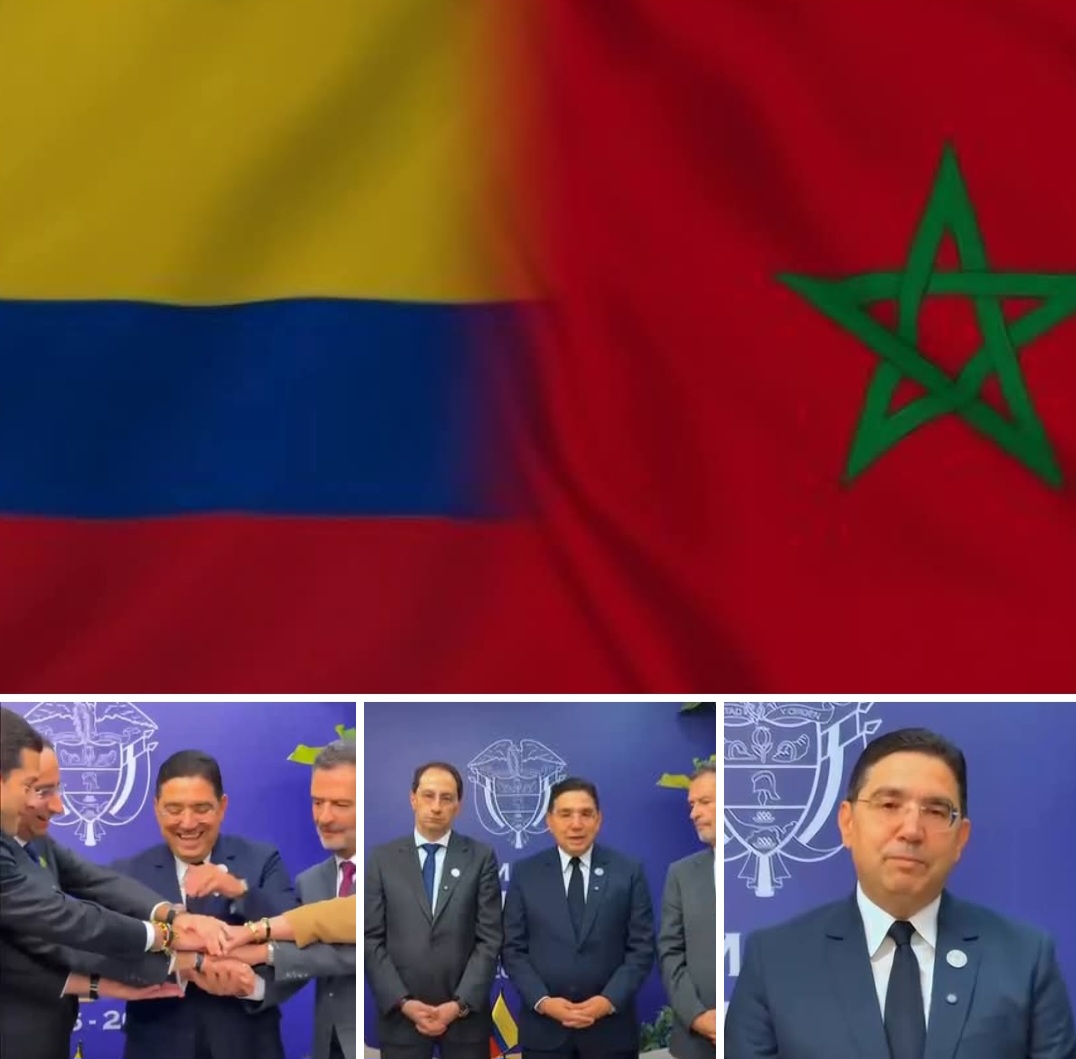
Colombia has announced a major shift in its position on the Western Sahara dispute, declaring its recognition of Morocco’s sovereignty over the territory’s southern provinces and withdrawing its previous recognition of the Sahrawi Arab Democratic Republic (SADR).
The announcement represents a significant diplomatic reversal for Bogotá and could open a new chapter in relations between Colombia and Morocco, with both sides signaling ambitions to transform their longstanding ties into a broader strategic partnership spanning trade, investment, political cooperation and South-South relations.
The policy change was announced during high-level talks involving Morocco’s Minister of Foreign Affairs, African Cooperation and Moroccan Expatriates, Nasser Bourita, Colombia’s Vice-President José Manuel Restrepo and Foreign Minister Omar Bula Escobar.
Bula Escobar confirmed Colombia’s new position, stating that Bogotá recognizes Morocco’s sovereignty over its Sahara.
Restrepo described the announcement as “a new beginning” for bilateral relations and characterized Morocco as “Colombia’s first ally in Africa.”
He also expressed Colombia’s determination to build a strategic partnership with the North African kingdom.
For Rabat, the announcement represents a significant diplomatic gain in its long-running campaign to secure international support for its position on Western Sahara.
Bourita described Colombia’s decision as “historic”, saying the move could provide substantial momentum to relations between the two countries.
Colombia’s decision marks a sharp departure from the position adopted under former President Gustavo Petro, whose government restored diplomatic recognition of the SADR in 2022.
The issue subsequently became politically contentious in Colombia.
In 2023, Colombia’s Senate overwhelmingly rejected the government’s position toward the Polisario-backed SADR, with more than 70% of senators opposing the policy, according to Colombian parliamentary records cited by Morocco’s official government portal.
The Senate had also adopted earlier pro-Moroccan motions in 2022 and 2023, receiving the support of 63 and 65 senators respectively.
The latest announcement therefore represents not merely a diplomatic adjustment but the culmination of several years of political debate within Colombia over how Bogotá should balance its relations with Morocco, Africa and the wider international community.
Four Decades of Diplomatic Relations
Colombia and Morocco have maintained diplomatic relations since January 1, 1979, giving the relationship more than four decades of institutional history.
According to Colombia’s embassy in Morocco, the two countries have cooperated across political dialogue, trade, culture, education and development.
Colombia opened an embassy in Rabat in 1990, later closing it in 2002 because of budgetary constraints before diplomatic representation was restored in 2013.
The relationship received another boost in May 2026 when Colombian Ambassador Carlos Arturo Forero Sierra presented his credentials to King Mohammed VI in Rabat.
That appointment was described by Bogotá as part of an effort to strengthen bilateral relations and establish a new phase of confidence and constructive partnership.
Trade Offers Another Strategic Opportunity
Beyond diplomacy, the two countries have significant room to expand economic cooperation.
Trade between Colombia and Morocco was reported at approximately US$350 million in 2022, with Colombia exporting commodities including coal, coffee and chemicals, while Morocco supplied fertilizers and agricultural products.
More recent United Nations COMTRADE data show that Colombian exports to Morocco reached approximately US$136.5 million in 2025, led overwhelmingly by mineral fuels and oils, which accounted for about US$114.8 million. Coffee, tea and spices represented another US$4.2 million.
Moroccan exports to Colombia stood at approximately US$16.6 million in 2024, including minerals, fertilizers, fats and oils, leather products and vehicles.
The relatively modest level of bilateral trade compared with the size of both economies highlights the potential for expansion.
Bourita suggested that Morocco and Colombia could serve as economic gateways for one another , Morocco into Africa and Colombia into Latin America creating opportunities for companies seeking access to new regional markets.
Western Sahara remains one of Africa’s longest-running territorial disputes.
The territory covers approximately 266,000 square kilometres along the Atlantic coast of northwest Africa.
Spain withdrew from its former colony in 1976, after which Morocco took control of much of the territory while the Polisario Front continued its campaign for independence.
The conflict resulted in decades of armed confrontation before a United Nations-backed ceasefire entered into force on September 6, 1991.
The UN established the United Nations Mission for the Referendum in Western Sahara (MINURSO) that year to support the settlement process and monitor the ceasefire.
The UN says hostilities resumed in November 2020, and MINURSO continues to monitor the security situation and support UN-led political efforts.
The dispute remains politically sensitive because Morocco regards Western Sahara as part of its territory and promotes autonomy under Moroccan sovereignty, while the Polisario Front seeks independence and the SADR claims sovereignty over the territory.
Colombia’s latest announcement therefore carries significance well beyond its bilateral relationship with Rabat.
Morocco’s Expanding Diplomatic Campaign
The Colombian decision comes amid a broader Moroccan diplomatic campaign aimed at increasing international support for its autonomy proposal and territorial position.
The United States recognized Moroccan sovereignty over Western Sahara in December 2020, a major shift in Washington’s longstanding policy.
Morocco has subsequently secured support from a growing number of countries for its autonomy initiative, while the United Nations continues to frame the dispute as requiring a negotiated political solution.
The latest Colombian position adds an important Latin American dimension to Morocco’s diplomatic strategy.
Bourita said Colombia’s decision could give “great momentum” to relations between Rabat and Bogotá.
He also emphasized the strategic geographic positions of the two countries, arguing that Morocco could function as a platform for Colombia to deepen its presence in Africa, while Colombia could provide Morocco with a stronger gateway into Latin American markets.
The Moroccan foreign minister’s presence in Cali, undertaken on the instructions of King Mohammed VI to represent the Moroccan monarch at the inauguration of Colombia’s new president, Abelardo de la Espriella, was presented as evidence of Rabat’s determination to capitalize on the diplomatic opening.
The message from both capitals is clear: the relationship is moving beyond traditional diplomatic exchanges toward a more ambitious strategic partnership.
Colombia’s decision could have wider implications for Morocco’s efforts to consolidate international backing for its position on Western Sahara, particularly in Latin America, a region where the issue has historically generated strong support for the Polisario-backed SADR.
For Bogotá, meanwhile, the policy change offers an opportunity to deepen engagement with one of Africa’s most strategically positioned economies and a country increasingly active in continental trade, investment and diplomatic initiatives.
The challenge now will be translating the political breakthrough into concrete agreements.
Trade, investment, agriculture, mining, fertilizers, energy, tourism, education, infrastructure and cultural exchanges could all form part of a new bilateral agenda.
With diplomatic relations dating back to 1979, Colombia and Morocco now appear poised to redefine their partnership.
The Sahara decision may have opened the door but the scale of the new Colombia-Morocco relationship will ultimately be measured by what comes next.


