


By: Julius Konton
President Joseph Nyuma Boakai has highlighted what his administration describes as tangible progress in Liberia’s civil service, education, and health sectors, framing the reforms as part of a broader attempt to dismantle decades of inefficiency, patronage, and post civil war institutional fragility.
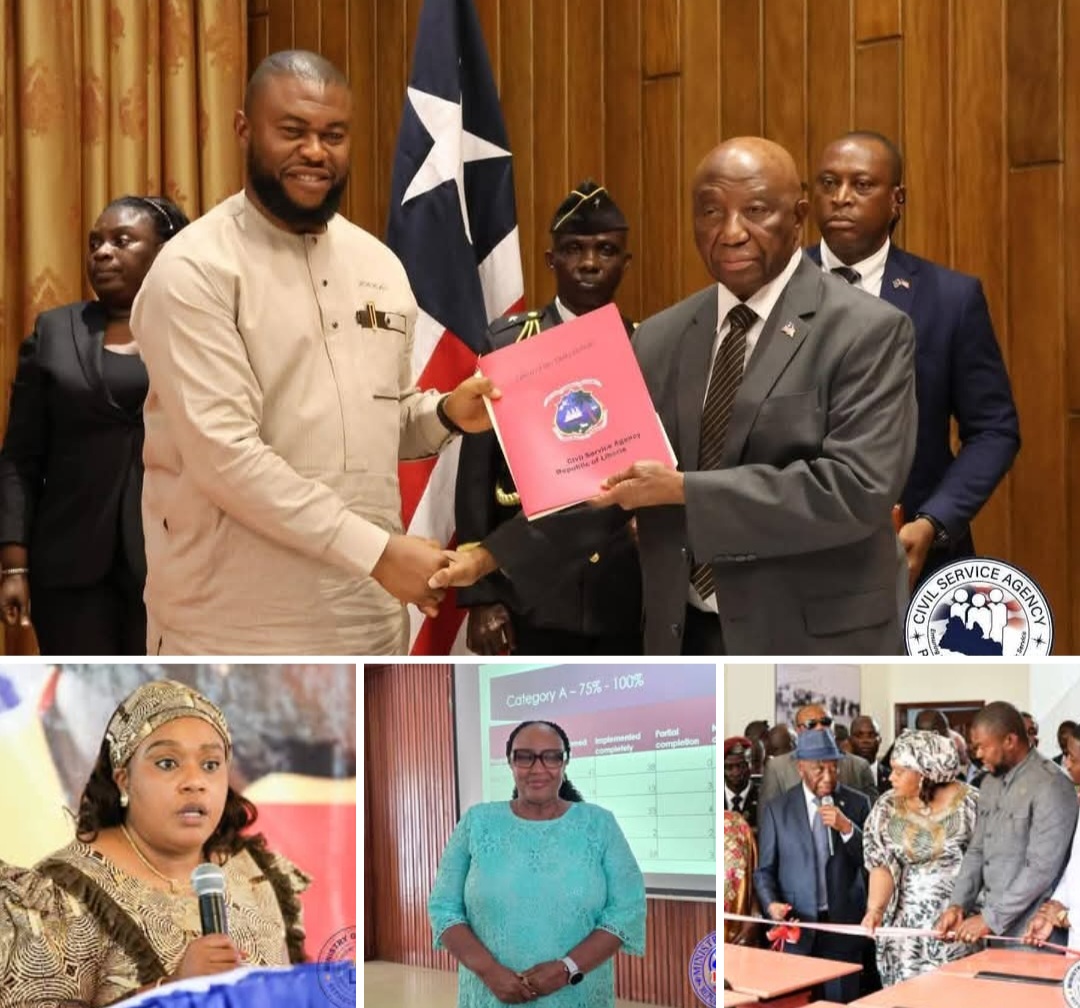
Delivering his third State of the Nation Address on Monday at the Capitol Building in Monrovia, Boakai underscored reforms carried out in 2025, particularly within the Civil Service Agency (CSA), a key institution historically criticized for bloated payrolls, weak accountability, and political interference.
Civil Service Reform: Merit Over Patronage
According to the President, the CSA intensified merit-based recruitment through the establishment of a Civil Service Testing Center, a move aimed at standardizing hiring practices and reducing political favoritism an entrenched problem in Liberia’s public administration since the end of the civil war in 2003.
Staff welfare measures were also expanded.
The government introduced a 50 percent salary-advance option, broadened long-term loan programs, and automated legal and administrative services to reduce bureaucratic delays, he re-emphasized.
These reforms, President Boakai argued, are intended to improve morale and productivity across the public sector.
One of the most politically significant announcements was the placement of more than 3,400 long-serving volunteers in the education and health sectors onto the national payroll, ending years of unpaid or irregular service for thousands of workers.
In addition, he stated that salaries were increased for over 23,000 frontline workers across health, education, security, and agriculture sectors that employ a large share of Liberia’s civil workforce and are critical to service delivery in rural areas.
Liberia’s civil service has long been characterized by wage compression and payroll distortions, problems compounded by years of donor dependency and weak domestic revenue mobilization.
Analysts say the administration’s challenge will be sustaining these reforms amid fiscal constraints.
Education: Payroll Cleanup and Digital Expansion
Education featured prominently in Boakai’s address, with the President describing human capital development as central to Liberia’s long-term recovery.
Under a unified, data-driven reform framework adopted in 2024, the government removed over 1,000 ghost names from the teachers’ payroll, a persistent issue that has undermined credibility and drained public resources.
The savings enabled the recruitment of more than 2,000 qualified volunteer teachers across all 15 counties.
Through the US$88.7 million EXCEL Project, financed by the World Bank and the Global Partnership for Education, the government prioritized early-grade literacy and numeracy, targeting Grades 1–3 to ensure foundational skills by age eight, he added.
He also told the national legislature that the National Digital Learning Platform has been expanded to reach remote communities with multimedia lessons, including sign-language-supported content, while 156 schools were equipped with computer laboratories and nearly 300 teachers trained in digital instruction.
Infrastructure gaps many of them legacies of the civil war were also addressed.
The government distributed over 26,000 desks and chairs under the “One Child, One Chair” initiative, constructed model schools in Bong, Margibi, and Nimba counties, renovated 40 schools, and supplied 22,000 STEM kits nationwide.
Partnerships with Tuskegee University and the Booker Washington Institute were announced to expand technical and vocational education, reflecting a renewed emphasis on skills training for youth employment.
The national school feeding program supported more than 239,000 students, while governance improved through the Annual School Census, which covered 6,394 schools after a four-year suspension.
Scholarship access he also indicated was also expanded, with local beneficiaries increasing from 378 to 1,000, and all arrears for 210 Liberian students studying abroad cleared.
Funds were further allocated to renovate the University of Liberia and public schools to ease overcrowding, a persistent post-war challenge.
Health Sector: Measurable Gains, Persistent Gaps
In the health sector, Boakai reported measurable improvements.
Maternal mortality declined nationwide, childhood immunization coverage for children under one rose to 88 percent, and medicine stockouts reportedly dropped sharply from 95 percent to 5 percent, a critical indicator in a country where access to essential drugs has often been unreliable.
Liberia’s immunization program benefited from renewed cooperation with Gavi, the Vaccine Alliance, with the government meeting its co-financing obligations for the first time in a decade, signaling improved fiscal discipline.
Infrastructure projects advanced, including the reconstruction of the C.H. Rennie Hospital in Margibi County at a new site in Kakata, now expanded to include a midwifery training school.
Construction of a Neuro-Psychiatric Hospital in Bensonville reached 75 percent, while a Regional Diagnostics Center in Bong County stands at 85 percent completion.
Human resource development continued with the launch of a midwifery training program at Bomi Community College, alongside budgetary support for the operation of ELWA Hospital, one of the country’s largest referral facilities.
To strengthen disease surveillance, the government established a National Health Intelligence Center, aimed at improving data-driven planning.
Early results show tuberculosis notifications increased by 7.6 percent, suggesting improved detection, while TB incidence and mortality declined by 28 percent and 49 percent, respectively.
Drug Abuse and Social Stability
Addressing a growing public health and security concern, Boakai announced the launch of Liberia’s first National Anti-Drug Action Plan, designed to curb both demand and supply of illicit drugs. By the end of 2025, over 800 at-risk youth had been enrolled in rehabilitation and recovery programs.
A Reform Agenda Under Scrutiny
While the administration presents these figures as evidence of steady progress, analysts caution that Liberia’s reform trajectory remains fragile.
The sustainability of wage increases, infrastructure investments, and social programs will depend heavily on economic growth, domestic revenue mobilization, and continued donor confidence.
Nevertheless, Boakai’s third State of the Nation Address marks a clear attempt to shift Liberia’s governance narrative from survival and stabilization to institutional reform nearly two decades after the end of its brutal civil conflict.
Whether these reforms translate into durable structural change remains a defining test for the Boakai’s administration.


