





By: Julius Konton
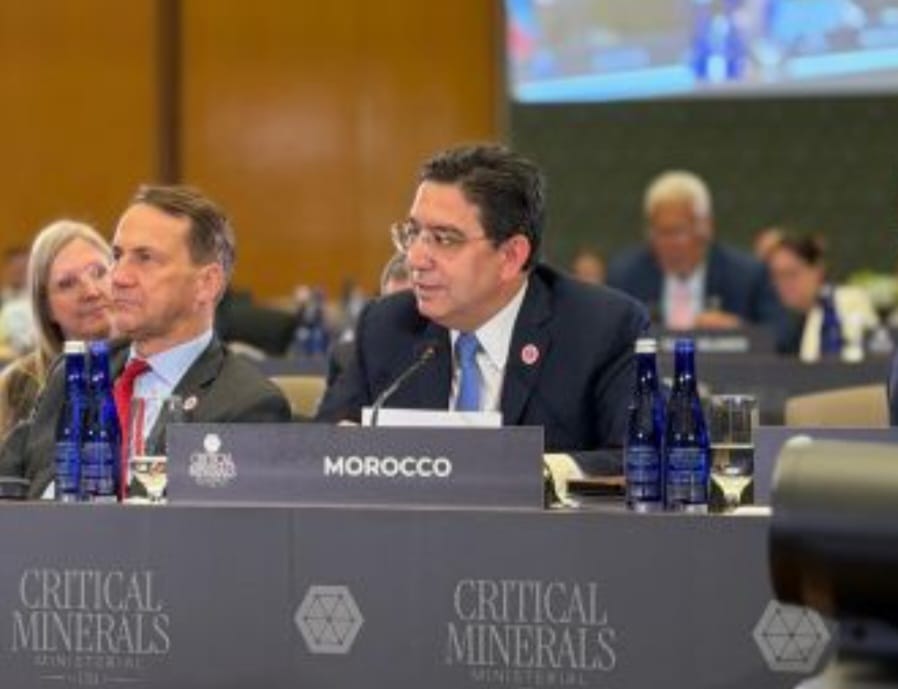
Under the leadership of His Majesty King Mohammed VI, the Kingdom of Morocco has emerged as a pivotal and reliable actor in the evolving global competition for critical minerals, positioning itself as a bridge between Africa, Europe, and the Americas, Morocco’s Minister of Foreign Affairs, African Cooperation and Moroccans Residing Abroad, Nasser Bourita, declared on Wednesday.
Speaking at a high-level ministerial meeting on critical minerals organized in Washington by U.S. Secretary of State Marco Rubio, Minister Bourita emphasized Morocco’s geostrategic relevance, political stability, and infrastructure readiness as decisive assets in an increasingly fragmented and geopoliticized global minerals market.
“The world does not lack minerals, nor rare earths,” Bourita said. “What is missing is responsible development, trust between nations, and transparent frameworks where partnership replaces dependence.”
Critical Minerals: A Growing Global Fault Line
Critical minerals such as lithium, cobalt, phosphates, rare earth elements, and manganese are essential for renewable energy technologies, electric vehicles, defense systems, semiconductors, and advanced manufacturing.
According to the International Energy Agency (IEA), global demand for these minerals is expected to triple by 2040, with clean energy technologies accounting for more than 70% of total growth.
Yet global supply chains remain highly concentrated, with over 60% of rare earth processing controlled by a single country, creating vulnerabilities that have turned minerals into instruments of geopolitical pressure.
Minister Bourita warned that current mining globalization is “neither free, nor fair, nor resilient.”
“It has transformed what should be a common foundation for global progress into an instrument of unilateral pressure.
This is not merely a supply chain issue, it is a structural imbalance.”
Morocco’s Strategic Advantage
Morocco holds over 70% of the world’s known phosphate reserves, a critical input for global food security and clean energy technologies.
The country has also invested heavily in port infrastructure, renewable energy, logistics corridors, and industrial ecosystems, including Africa’s largest port, Tanger Med, and one of the world’s most competitive renewable energy complexes at Noor Ouarzazate.
These investments, coupled with Morocco’s long-standing political stability and diplomatic credibility, have positioned the Kingdom as a preferred partner for responsible and diversified mineral supply chains.
Africa at the Center of a New Global Pact
Minister Bourita stressed that Africa must no longer be relegated to the role of raw material exporter, recalling a key message from King Mohammed VI to the 2025 Ibrahim Governance Weekend Forum.
According to global estimates:
Africa holds 40% of the world’s raw material reserves
Accounts for 30% of global strategic mineral deposits
Yet captures less than 10% of global mining value addition
“We can no longer allow our continent to be a mere exporter of raw materials,” the King stated in the Royal Message.
Bourita called for massive investment in African infrastructure, governance systems, and human capital, arguing that only value-added production can translate mineral wealth into jobs, industrialization, and long-term prosperity for African populations.
Call for a ‘Loyalty Pact’ in Global Minerals Trade
In a notable policy proposal, Morocco’s top diplomat urged the creation of a “loyalty pact” among producers, processors, and end-users, grounded not in ideology but in strategic respect, sovereignty, and shared benefit.
Such a pact, he argued, would:
Reduce coercive dependencies
Encourage transparent pricing and traceability
Ensure ethical labor and environmental standards
Distribute economic gains more equitably across regions
“If this century is to be marked by critical minerals, let it also be one of reliable partnerships, mutual respect, and shared stability,” Bourita concluded.
Morocco–U.S. Strategic Agreement Signed
On the sidelines of the ministerial meeting,
Morocco and the United States signed a Memorandum of Understanding (MoU) to strengthen cooperation in critical minerals and rare earths, signaling Washington’s growing interest in diversifying supply chains away from geopolitical risk zones.
The agreement is expected to cover:
Exploration and processing cooperation
Investment facilitation
Technology transfer
Sustainable mining practices
Analysts view the MoU as part of a broader U.S. strategy to secure reliable partners amid rising global competition for minerals vital to the energy transition and national security.
A New Minerals Diplomacy Emerges
As global powers recalibrate their industrial and security strategies, Morocco is positioning itself not merely as a supplier, but as a norm-setter in the governance of critical minerals advocating for a future where resources become instruments of cooperation rather than confrontation.
In an era defined by energy transition and geopolitical realignment, Rabat’s message in Washington was clear: stability, trust, and shared prosperity must define the minerals economy of the 21st century.


