
By: Julius Konton
Liberian President Joseph Nyuma Boakai, Sr. has reaffirmed agriculture as the backbone of Liberia’s economic recovery and long-term prosperity, unveiling new data that shows steady sector growth while outlining an ambitious national push for rural roads, mechanization, and food self-sufficiency.
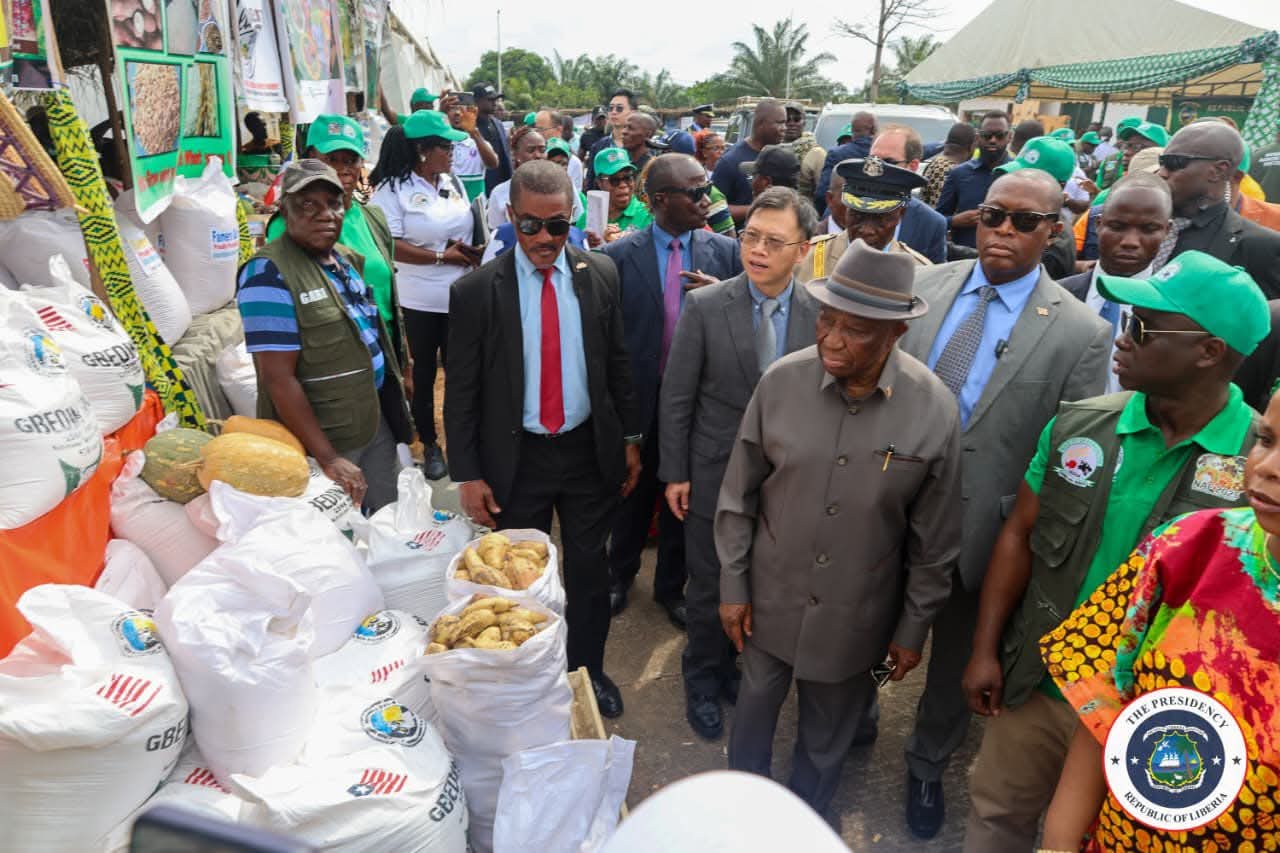
Speaking at the official opening of the National Agriculture Fair (NAF) 2025 in Gompa City, Nimba County, President Boakai told farmers, development partners, and government officials that Liberia’s fertile land, resilient farmers, and renewed policy focus are beginning to yield measurable economic dividends.
“If you put your finger in our soil and leave it there, it might germinate,” the President said, underscoring Liberia’s natural agricultural potential. “That is how fertile our land is and how strong our future can be if we invest wisely”, he re-emphasized.
Agriculture Driving Economic Growth
According to World Bank figures cited by the President, Liberia’s economy expanded by 4.0 percent in the last fiscal year, with agriculture accounting for a substantial share of that growth.
The sector recorded a 3.4 percent expansion, contributing 1.3 percentage points to national GDP growth.
Key production gains include:
Rubber output rising by nearly 18 percent
Rice production, Liberia’s staple food, increasing by 8.5 percent
Improved yields in cassava, cocoa, and livestock subsectors
The President attributed these gains to improved policy coordination, better access to farm inputs, and ongoing investments in rural infrastructure.
However, he cautioned that production alone is insufficient without reliable market access.
Feeder Roads to Unlock Rural Economies
To address long-standing logistical bottlenecks, the Boakai’s administration has placed feeder road rehabilitation at the center of its agricultural strategy.
The government recently launched the rehabilitation of 144 kilometers of feeder roads in Lofa County, one of Liberia’s major food producing regions.
“These roads do more than move crops,” Boakai said. “They reduce transport costs, prevent post harvest losses, link farmers to markets, connect children to schools, and families to health care”, he told the gathering.
The President announced that similar feeder road projects will be rolled out nationwide to fully integrate rural communities into the national economy.
Mechanization Drive Targets Gender Equity and Productivity
Highlighting the central role of women in Liberia’s agricultural workforce who account for more than 60 percent of farm labor , President Boakai unveiled plans to establish 13 fully operational agricultural mechanization service centers by 2026.
The centers will provide access to tractors, harvesters, and processing equipment aimed at:
Reducing back-breaking manual labor, especially for women
Increasing farm productivity and efficiency
Enhancing incomes and livelihoods in rural communities
“Mechanization is not just about machines,” Boakai said. “It is about dignity, equity, and giving women and young people the tools they need to succeed”, he added.
Youth, Technology, and Modern Agriculture
The President also called on Liberian youth to embrace agriculture as a modern, technology-driven industry, highlighting opportunities in agribusiness, logistics, data analytics, climate-smart farming, and value-chain development.
“From drones and digital mapping to processing plants and export markets, agriculture today is innovation,” he said. “Liberia needs its young people to lead this transformation”, he rally the young people.
Partnerships and National Ownership
Boakai expressed gratitude to international partners including FAO, IFAD, the World Bank, African Development Bank, WFP, and the European Union for their sustained support, while emphasizing the importance of national ownership.
“The future of Liberian agriculture must be shaped by Liberians,” he said. “We must buy what we produce, support our farmers, and believe in our own capacity to feed ourselves.”
Food Security as National Freedom
Quoting traditional wisdom, the President framed food security as a cornerstone of sovereignty.
“The hand that feeds you controls you, but the hand that feeds itself is free.”
As he officially declared the National Agriculture Fair 2025 open, President Boakai urged unity among government, farmers, youth, and partners, reaffirming that agriculture remains central to Liberia’s development agenda.
“When agriculture grows, Liberia grows,” he concluded. “When we feed ourselves, we free ourselves.”
Editor’s Note
This article captures a pivotal moment in Liberia’s development trajectory, highlighting the Boakai administration’s renewed emphasis on agriculture as both an economic engine and a pillar of national sovereignty.
By combining fresh growth data, infrastructure commitments, and a forward-looking mechanization agenda, the report underscores how policy, investment, and rural inclusion are beginning to translate into measurable gains.
The President’s remarks at the National Agriculture Fair 2025 reflect a broader shift from subsistence-focused interventions toward market-oriented, technology-driven farming, with special attention to women and youth who form the backbone of the sector.
The emphasis on feeder roads, mechanization centers, and food self-sufficiency situates agriculture not only as a livelihood issue but as a strategic pathway to economic resilience, reduced import dependence, and long-term stability.
As Liberia continues to navigate post-crisis recovery and global economic headwinds, the developments outlined in this article offer readers insight into how agriculture is being repositioned at the center of national growth, rural transformation, and self-reliance.
