
By: Julius Konton
Finance and Development Planning Minister Augustine Kpehe Ngafuan said Liberia has formally begun the next and most demanding phase of its engagement with the United States Millennium Challenge Corporation (MCC) following the country’s reaffirmation for a second compact.
He made the statement during a high-level meeting with a visiting U.S. delegation in Monrovia.
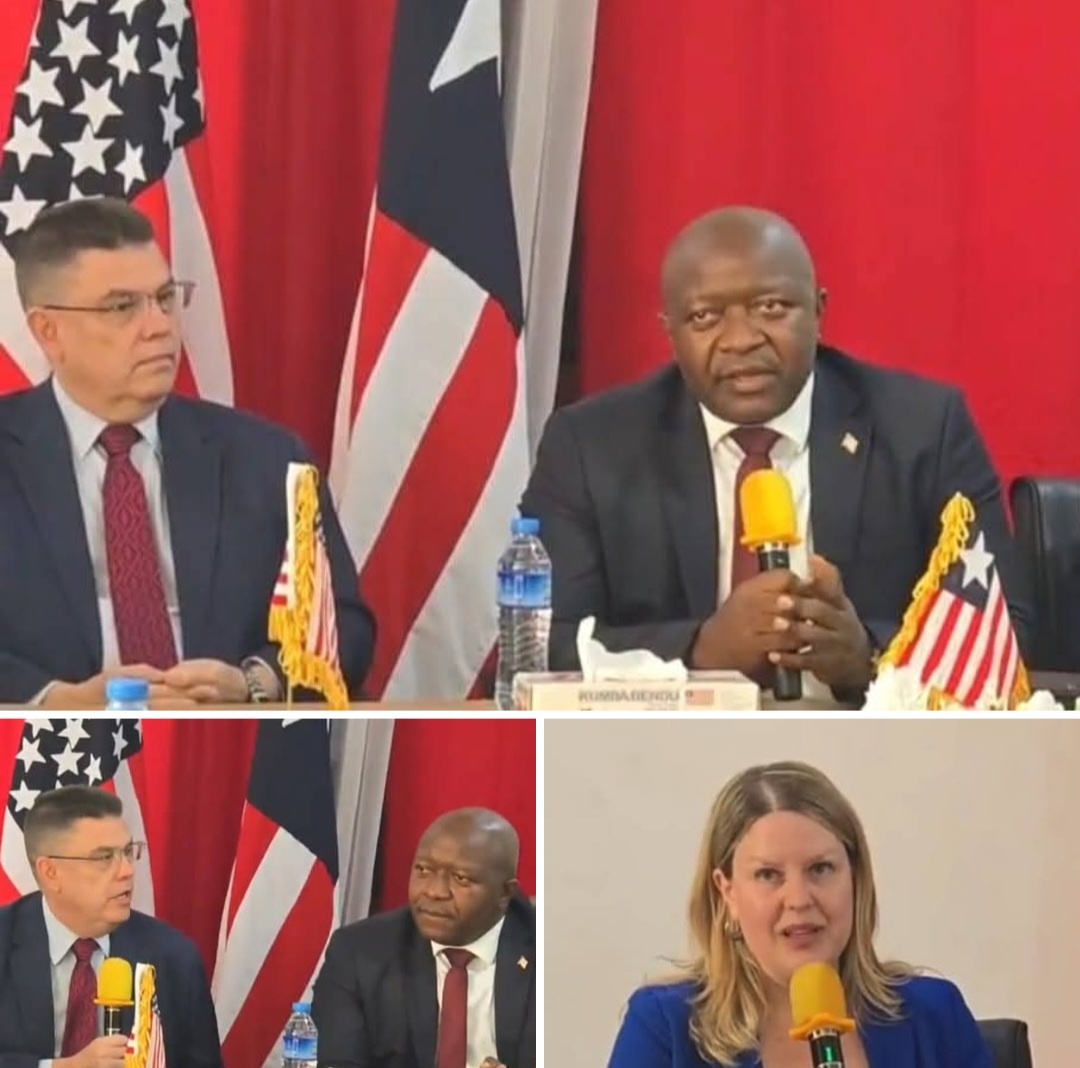
Minister Ngafuan along with Senior officials from the Ministry of Finance and Development Planning (MFDP), representatives of line ministries, and members of the U.S. Embassy joined MCC officials to outline the roadmap for compact development, an ambitious, data-driven process expected to last up to two years.
A Hard-Won Reaffirmation
In his opening remarks , Minister Augustine Kpehe Ngafuan told the US Delegation that Liberia’s return to the MCC compact development process did not come easily.
“The journey to reaffirmation was marked by intense scrutiny, difficult reforms, and candid engagement with international partners.
“This was not a smooth or straight road, It required honest conversations, strong partnerships, and sustained efforts to address concerns and demonstrate that Liberia is deserving of a second compact”, he re-emphasized.
The MCC Board’s reaffirmation places Liberia among a small group of low- and middle-income countries globally deemed eligible to develop a compact, an achievement that reflects progress in governance, economic reform, and policy performance.
Since its creation by the U.S. Congress in 2004, MCC has invested more than US$16 billion across over 45 countries, focusing on poverty reduction through economic growth.
Liberia previously benefited from a US$257 million first compact (2016–2021), which targeted energy and road infrastructure, significantly improving electricity access in Monrovia and reducing transportation costs.
“Now the Real Work Begins”
The Finance Minister stressed that reaffirmation marks the beginning not the end of a demanding reform and development process.
“Now that we have been reconfirmed, the job truly starts, This is another long road that will require discipline, hard work, and a coordinated government-wide approach to deliver results”, he maintained.
He assured the visiting MCC team that it intends to accelerate preparations so the compact development phase progresses efficiently.
Although the development timeline spans up to two years, Minister Ngafuan said its actual duration will depend on Liberia’s pace and institutional readiness.
Recruitment Underway, February Milestones Targeted
As part of the immediate next steps, the government has begun recruiting personnel for a new MCC compact development office.
Vacancy announcements have already been issued, drawing what he described as an “overwhelming” response from qualified Liberians.
Working closely with MCC and development partners, the government aims to install the compact leadership team by February 2026, ahead of deeper technical workshops and sectoral discussions.
“We want key manpower in place before the intensive analytical sessions begin,” he noted. “This will allow us to move quickly and decisively.”
Whole-of-Government Commitment
While the MFDP serves as the coordinating institution, Minister Ngafuan emphasized that compact development is a whole-of-government effort, involving multiple ministries and agencies.
“Beyond the Ministry of Finance, sector ministers and technical teams across government have been fully engaged,” “This is not the work of one institution, it is the work of the entire government”, he told the delegation.
According to him, Public expectations are also high and the government acknowledged widespread excitement among Liberians as such pledged convert public optimism into measurable economic outcomes.
U.S. Embassy Welcomes New Beginning
For his part, the Chargé d’Affaires of the U.S. Embassy accredited near Monrovia Joseph Zadrozny thanked the Liberian government for the warm reception, describing the visit as “a strong way to begin the new year and the new MCC compact.”
He reaffirmed the embassy’s commitment to working closely with Liberian institutions as the process advances, citing the longstanding diplomatic and development partnership between the two countries.
MCC: “There Were Cheers When Liberia Was Reaffirmed”
Leading the MCC delegation,
Carrie Monahan, the Managing Director for Africa at the Millennium Challenge Corporation (MCC) commended the Liberian government for its hospitality and praised all ministries involved in the reaffirmation process.
She noted that competition for MCC compact development slots was particularly intense this year, making Liberia’s reaffirmation especially significant.
“There were cheers around the building following Liberia’s reaffirmation,” she said. “We are extremely happy to be where we are today.”
According to her, the MCC Board considered several key factors in approving Liberia’s continuation, including the deep historical ties between Liberia and the United States, the strength of bilateral relations, and the strong performance of Liberia’s first MCC compact.
“That first compact was ambitious, and MCC is very proud of the results,” she said, adding that these achievements weighed heavily in the Board’s decision.
Data-Driven, Country-Led Process
Carrie explained that MCC compacts are grounded in rigorous economic analysis and extensive data collection to identify the most binding constraints to growth.
“We collect a lot of data to truly understand what is holding back economic growth in specific sectors,” she said. “We also consult widely not just with government, but with the private sector, civil society, and ordinary Liberians.”
As part of the current mission, MCC officials are meeting with government stakeholders to outline the compact development framework and key milestones.
One major step will be a Root Cause Analysis Workshop scheduled for February.
“This process defines not just the problems in a sector, but the underlying causes of those problems,” she explained. “That is how we design projects that address real constraints, not symptoms.”
She emphasized that while MCC provides technical and financial support, the process must remain country-led.
“This compact will be driven by the Government of Liberia,” she said. “It must be collaborative, inclusive, and responsive to the needs of the Liberian people.”
Both sides expressed optimism that, despite the ambitious two-year target for compact signing, sustained collaboration and disciplined execution could deliver a transformative development program.
“We are happy to be here,” the MCC official concluded, “and we look forward to a productive mission and a strong partnership as Liberia moves forward.”
