




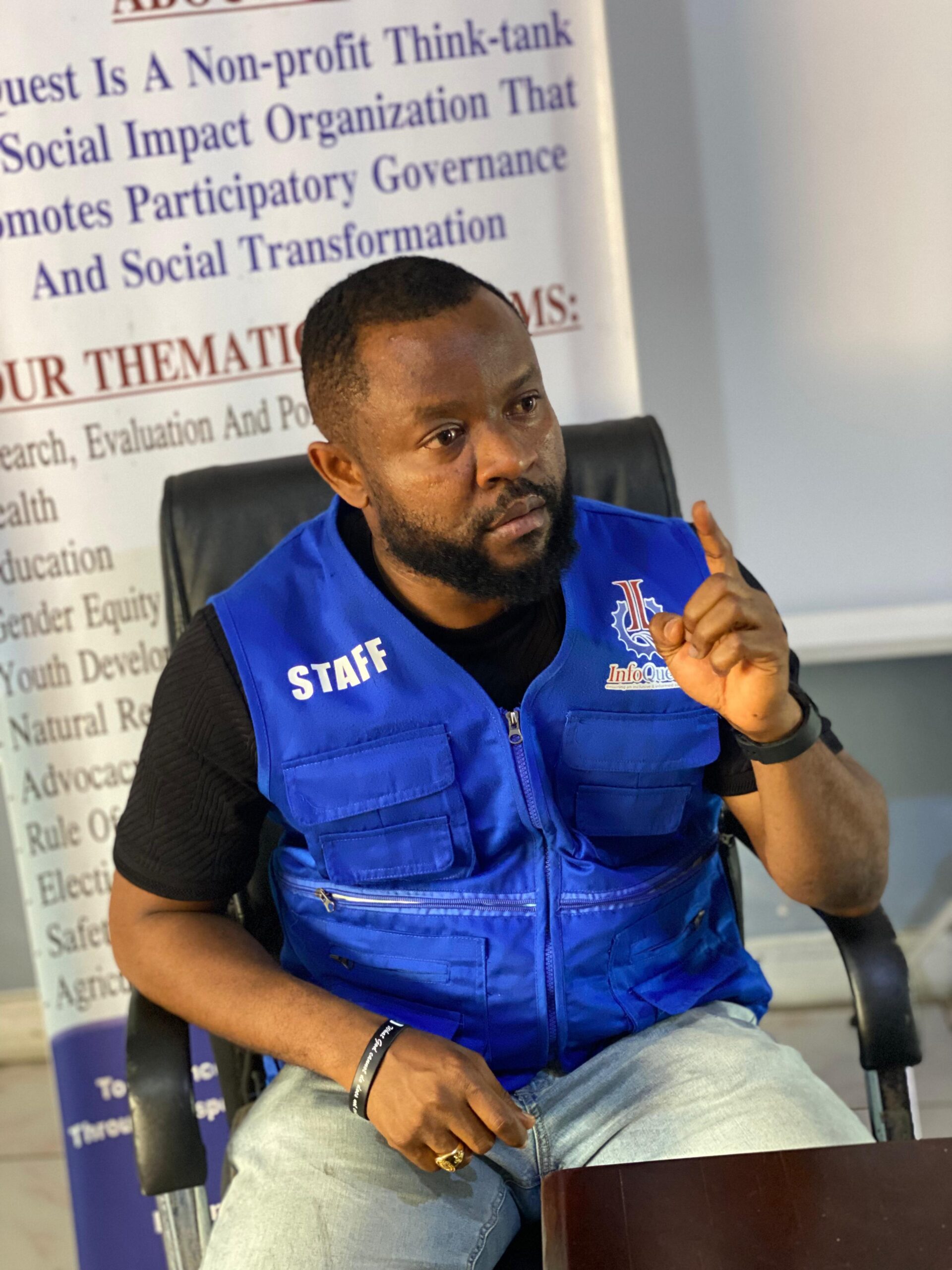
By: Julius Konton
Civil society organization InfoQuest Liberia has strongly criticized the Government of Liberia’s decision to extend the mandate of the country’s Asset Recovery Team, arguing that the move undermines ongoing institutional efforts to combat corruption.
In a press statement issued Thursday, the Executive Director of InfoQuest Liberia, Matthias Yeanay, described the extension as “unjustified and ineffective,” urging the government to instead redirect financial and logistical resources toward the Liberia Anti-Corruption Commission (LACC), the country’s principal anti-graft institution.
Mr. Yeanay emphasized that while the Asset Recovery Team was originally created to help trace and reclaim public assets allegedly lost through corruption, the body has yet to demonstrate significant results that would warrant a continuation of its mandate.
“Apart from issuing periodic press statements, the Asset Recovery Team has not presented tangible evidence of recovered public assets or successful legal actions that justify renewing its mandate,” Yeanay stated.
Call for Strategic Reallocation of Resources
InfoQuest Liberia is recommending that funds currently allocated to the Asset Recovery Team be redirected to the Liberia Anti-Corruption Commission, which the organization says has shown measurable progress in investigating and prosecuting alleged corruption cases.
According to Yeanay, strengthening the LACC would enhance Liberia’s broader anti-corruption architecture by consolidating investigative powers within an established statutory institution.
“The LACC has recorded significant gains in pursuing corruption cases and building legal frameworks for accountability,” Yeanay noted.
“Redirecting resources to the Commission will help reinforce the rule of law and avoid duplication of mandates.”
Liberia’s Long Battle Against Corruption
Corruption has remained one of Liberia’s most persistent governance challenges since the end of the country’s 14-year civil conflict in 2003.
Successive governments have pledged reforms aimed at strengthening transparency and public accountability.
The Liberia Anti-Corruption Commission, established in 2008, was created to investigate and prosecute corruption-related offenses.
However, analysts have long argued that the Commission has struggled with limited funding, staffing constraints, and legal challenges.
Transparency advocates note that Liberia has often ranked poorly on global anti-corruption indicators.
In recent years, the country has hovered around the lower half of Transparency International’s Corruption Perceptions Index, reflecting ongoing concerns about public sector accountability.
Civil society groups argue that improving institutional capacity and ensuring the independence of anti-corruption bodies are essential to reversing this trend.
Debate Over the Asset Recovery Team
The Asset Recovery Team was formed as part of government efforts to trace and reclaim public resources allegedly lost through corruption and financial mismanagement.
Such teams are common in post-conflict or reforming economies, where governments attempt to recover funds siphoned through illicit financial flows.
However, critics say the Liberian team has yet to demonstrate clear results.
According to InfoQuest Liberia, the absence of publicly disclosed statistics on recovered assets, concluded investigations, or successful prosecutions raises questions about the team’s effectiveness.
“Accountability institutions must be judged by measurable outcomes,” Yeanay said.
“Without transparent reporting on recovered funds or successful cases, extending the mandate risks creating a redundant structure within the anti-corruption framework.”
Growing Civil Society Pressure
The statement by InfoQuest Liberia adds to growing calls from civil society organizations for the government to strengthen existing institutions rather than creating parallel structures.
Governance experts say that overlapping mandates among anti-corruption bodies can weaken enforcement efforts and create institutional conflicts.
“Liberia needs a coordinated anti-corruption strategy,” Yeanay stressed. “Empowering the LACC with adequate resources and legal authority would deliver more sustainable results than maintaining ad-hoc task forces.”
A Test of Government Commitment
Observers say the debate surrounding the Asset Recovery Team’s mandate highlights broader questions about the government’s commitment to transparency and accountability.
As Liberia continues efforts to attract international investment and rebuild public confidence in governance institutions, anti-corruption reforms remain a central pillar of national development.
For InfoQuest Liberia, the path forward is clear.
“Liberia’s fight against corruption requires strong institutions, transparency, and measurable results,” Yeanay concluded.
“Redirecting resources to the Liberia Anti-Corruption Commission will strengthen the country’s ability to hold public officials accountable and recover stolen public wealth.”


