



By: Julius Konton
The President of the Liberia Football Association, Mustapha Raji, has announced an ambitious long-term strategy aimed at making Liberian football financially sustainable and less dependent on external support from world football governing body FIFA.
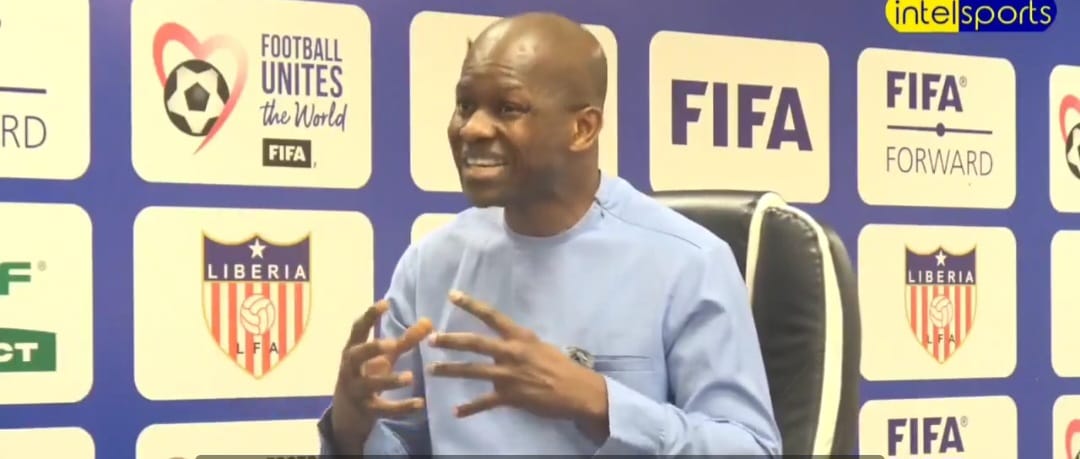
Speaking on the popular sports platform Intel Sports during the program LFA Decides, Raji outlined a comprehensive vision that includes investments in football academies, sports manufacturing, hospitality, agriculture, and commercial enterprises designed to generate independent revenue for the country’s football sector.
The announcement comes at a time when many African football associations continue to rely heavily on FIFA Forward funding, a development initiative launched by FIFA in 2016 to strengthen football infrastructure and administration worldwide.
Under the FIFA Forward Program, member associations can receive millions of dollars in support for operational costs, infrastructure, youth development, and technical programs.
However, Raji said the Liberian Football Association is now seeking to build a model capable of surviving even in the absence of international financial assistance.
“There is no limit or boundary for us,” Raji declared. “This is not only about sponsorship.
It is about exploring ways for the LFA to become involved in agriculture, restaurants, business and other ventures so that the profits can be reinvested into football development.”
Henry Nyumah Brown Academy to Anchor Youth Development
Central to the LFA’s sustainability blueprint is the establishment of the Henry Nyumah Brown Academy, a football academy expected to operate exclusively under the Football Association.
According to Raji, the academy will recruit, nurture and develop young Liberian football talents while creating future transfer and marketing opportunities for the country.
Football academies across Africa have increasingly become major economic assets.
Countries such as Senegal, Ghana, Nigeria, and Ivory Coast have generated millions of dollars through player transfers to European and Asian leagues.
Senegal’s famed Génération Foot Academy, for example, helped develop international stars including Sadio Mané, while academies in Ghana and Nigeria continue to feed top clubs across Europe.
Raji believes Liberia can follow a similar path.
The academy, he said, will not only develop elite players but also create a long-term revenue stream for the association through talent exports and partnerships with international clubs.
“The funds generated from the academy will be reinvested directly into football programs in Liberia,” he explained.
LFA Plans Local Production of Footballs
In another groundbreaking initiative, the LFA president disclosed plans for the association to begin producing its own footballs locally.
The move is intended to reduce the high cost of sports equipment faced by local clubs and academies while simultaneously generating additional income for the Football Association.
Liberian football clubs, particularly in lower divisions, have historically struggled with equipment shortages and financial constraints.
Many community clubs operate on limited budgets and depend heavily on donations or support from football authorities.
Raji said locally manufactured footballs would be sold at affordable prices to clubs, schools and communities.
“The footballs will be marketed at a very low cost, helping clubs save money, while profits will again be reinvested into the growth of the game,” he stated.
Sports economists note that sports merchandising and equipment manufacturing have become major revenue generators globally, with the international football equipment market valued in billions of dollars annually.
Football House Hotel Project Unveiled
Raji also revealed plans for the construction of an LFA-owned hotel to accommodate national teams and visiting football delegations.
The proposed facility, expected to be known as the LFA Hotel, is aimed at addressing long-standing accommodation challenges faced by Liberian national teams.
Liberia’s football authorities have often faced criticism over logistical difficulties surrounding national team camps, accommodation costs, and travel arrangements for players and officials.
“Today we still owe the RLJ and we should be doing that for national teams,” Raji noted, referencing past accommodation obligations.
He said the hotel would guarantee quality lodging and improved comfort for players representing Liberia at home and abroad, while also functioning as a commercial investment capable of generating consistent revenue for the association.
Across Africa, several football federations have increasingly ventured into hospitality and infrastructure investments as part of broader financial sustainability strategies.
Reducing Dependence on External Funding
The LFA president emphasized that the overall objective is to transform Liberian football into a self-sustaining institution capable of funding its own development projects.
Liberia, a nation of roughly 5.5 million people, has passionate football support but continues to face major infrastructure and financial challenges.
The country has produced world-class talents, most notably George Weah, the only African player to have won the FIFA Ballon d’Or and World Player of the Year awards.
Despite that rich football history, the country has struggled to consistently compete at the highest continental level due largely to financial and infrastructural limitations.
Raji argued that commercial diversification is necessary if Liberian football is to remain competitive in modern football administration.
“These are long-term plans,” he said. “Our administration is laying the foundation for future generations to continue building the game.”
Building a Leadership Legacy
Currently serving what is expected to be his third term as LFA president, Raji said his administration is focused not only on projects but also on preparing a new generation of football leaders.
He highlighted efforts made under his leadership to increase Liberian representation within regional and international football institutions such as West African Football Union, Confederation of African Football and FIFA.
“We do not want the LFA to be only about Mustapha Raji,” he explained. “When we took over, we pushed Liberians into positions within WAFU, CAF and FIFA.
We want to continue networking and introducing others to football leadership so they can succeed when we are no longer at the LFA.”
Football analysts say the strategy reflects a growing trend among African football federations seeking financial independence and institutional continuity beyond individual leadership eras.
If successfully implemented, Liberia’s model could become one of the most ambitious football sustainability projects in West Africa potentially transforming the country’s football economy for decades to come.


