




By: Julius Konton
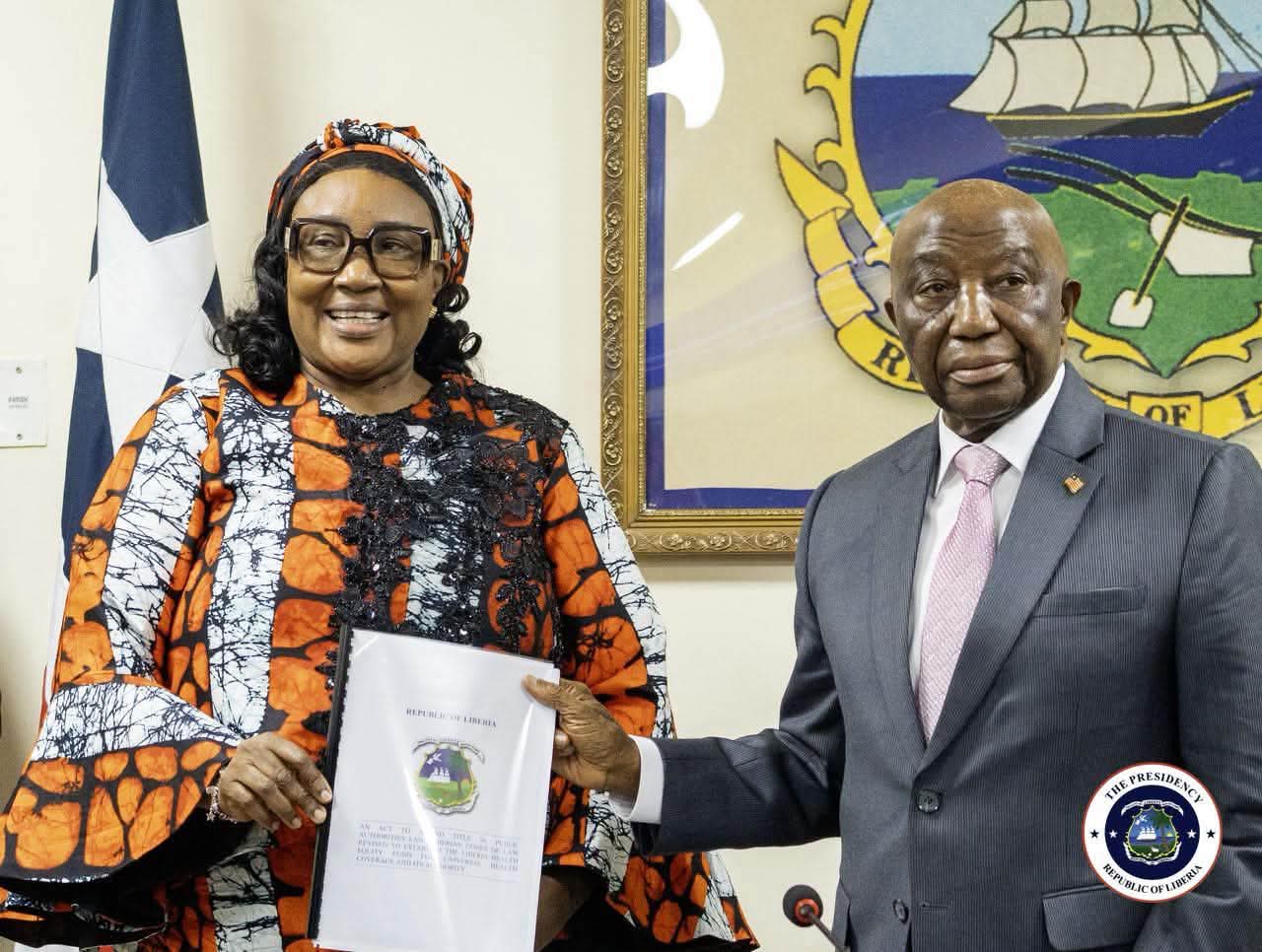
In what could mark one of the most transformative healthcare reforms in Liberia’s post-war history, President Joseph Nyuma Boakai has received the proposed Liberia Health Equity Fund for Universal Health Coverage (LHEF) Bill, a major legislative framework aimed at establishing the country’s first sustainable national health insurance scheme.
The proposed bill, submitted by the Minister of Health Dr. Louise Kpoto at the Executive Mansion in Monrovia, seeks to establish the Health Equity Authority of Liberia (HEAL), an independent institution that would oversee the implementation, regulation, and administration of a nationwide health insurance system designed to provide equitable healthcare access for all Liberians and legal residents.
The initiative comes at a critical time for Liberia’s health sector, where out-of-pocket spending remains one of the highest in West Africa.
According to World Bank and WHO estimates, more than 35% of Liberia’s total health expenditure is paid directly by households, often pushing vulnerable families deeper into poverty during medical emergencies.
President Boakai described the bill as a “major milestone” toward achieving affordable and accessible healthcare, emphasizing that government has a constitutional and moral obligation to protect the health of its people.
“The health of the people is the responsibility of the government,” President Boakai declared. “If we give our people quality education and full access to healthcare, Liberia will become a stronger and greater nation.”
A New Chapter in Liberia’s Health Sector
Liberia’s healthcare system has long struggled under the weight of inadequate infrastructure, limited financing, and the legacy of the 1989–2003 civil conflict, which destroyed nearly 95% of the country’s health infrastructure.
The devastating 2014–2016 Ebola outbreak, which claimed over 4,800 lives in Liberia alone, further exposed the country’s fragile health system and the urgent need for stronger healthcare financing mechanisms.
The proposed LHEF aligns with the Sanitation and Health Pillar of President Boakai’s ARREST Agenda for Inclusive Development (AAID), a national policy blueprint focused on Agriculture, Roads, Rule of Law, Education, Sanitation, and Tourism.
Health experts say the reform could significantly improve Liberia’s progress toward achieving the United Nations Sustainable Development Goal 3 (SDG-3) on universal health coverage by 2030.
How the Fund Will Be Financed
According to the Ministry of Health’s proposal, the Liberia Health Equity Fund will draw financing from multiple statutory sources to ensure long-term sustainability.
These include:
0.5% to 1.0% salary contributions from formal sector workers, managed through (NASSCORP), with shared employer-employee contributions.
1% to 3% of Value Added Tax (VAT) revenues.
A one-cent levy on all mobile money transactions nationwide.
Mandatory contributions from Class A and B mining concession companies, including major extractive operators.
Lump-sum contributions from informal sector groups
10% of national excise tax revenues.
5% of pollution-related revenues and environmental taxes.
Levies on private health insurance and health-related service providers.
Liberia’s mobile money sector alone processed an estimated over US$2 billion in transaction volume in 2025, suggesting the digital levy could become a significant revenue stream for the fund.
Public Awareness Key to Success
President Boakai stressed that public understanding and national participation will be essential for the success of the insurance scheme, calling for an aggressive nationwide awareness campaign to educate citizens about the benefits of health insurance.
Drawing lessons from countries such as , Japan, Ghana, Gabon, Rwanda and whose national insurance systems have expanded healthcare coverage to millions, the Liberian leader noted that Liberia does not need to “reinvent the wheel” but should adapt successful models to fit local realities.
Health policy analysts believe that if passed by the Legislature and effectively implemented, the LHEF could become one of Liberia’s most consequential social protection reforms, potentially reducing maternal mortality, increasing access to essential medicines, and protecting thousands of households from catastrophic health expenditures.
For a country where life expectancy currently stands at approximately 65 years and maternal mortality remains among the highest globally at about 652 deaths per 100,000 live births, the stakes could not be higher.
As Liberia pushes toward a more resilient healthcare future, the proposed Health Equity Fund signals a bold step toward ensuring that no citizen is denied care because of poverty.


