



By: Julius Konton
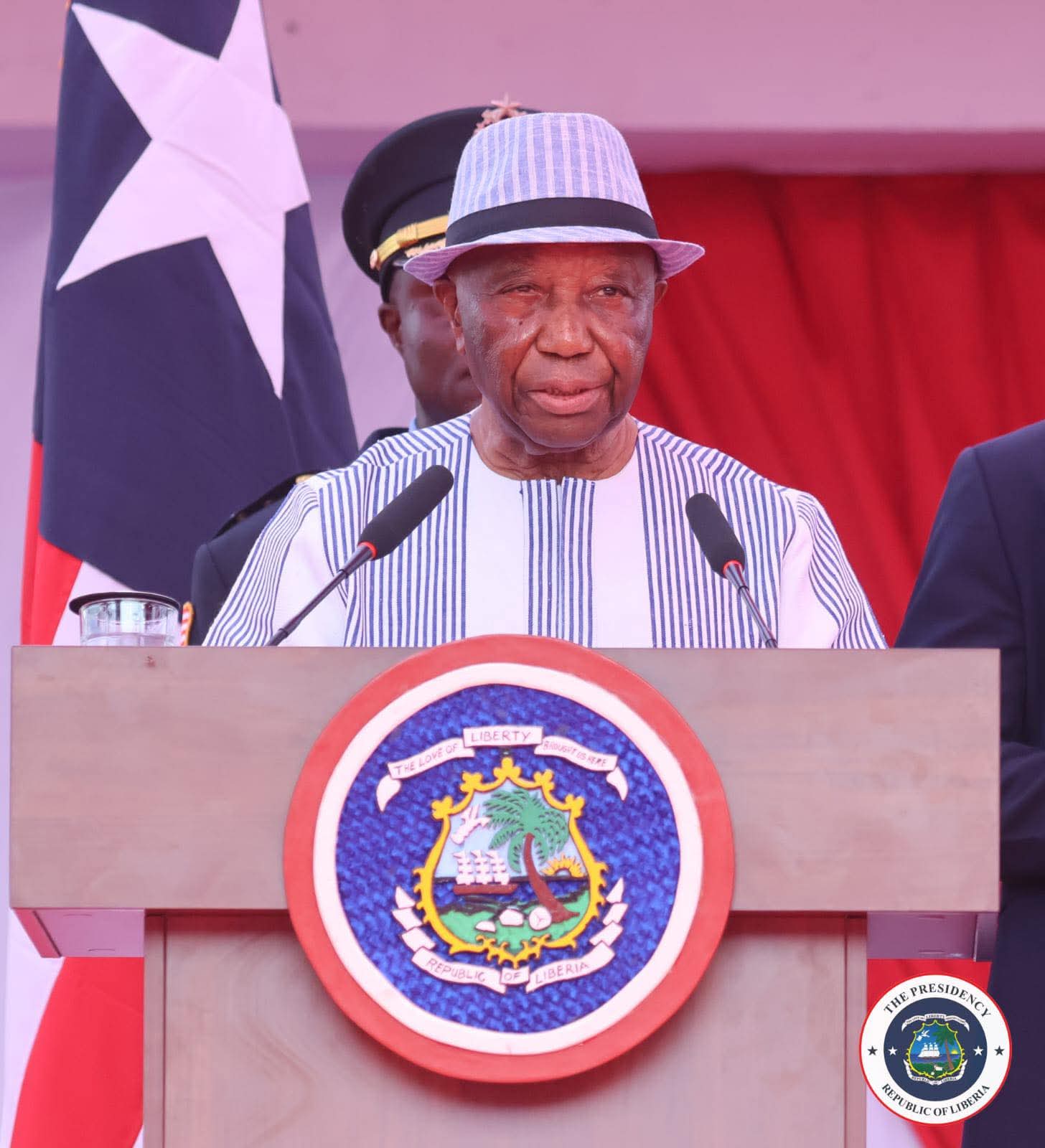
President Joseph Nyuma Boakai on Monday delivered his third State of the Nation Address (SONA) to the Liberian people, a constitutionally mandated annual report that arrives at a moment of institutional strain, cautious economic recovery, and unresolved political trauma.
Speaking not from the historic joint chamber of the Legislature but once again from the Capitol’s outdoor courtyard Boakai underscored a sobering reality: Liberia’s democracy remains under physical and symbolic repair following the 2024 arson attack on the Capitol Building, an incident that shook public confidence and exposed deep political fault lines.
A Constitution Observed, a Crisis Remembered
In keeping with Article 58 of the 1986 Constitution, the President presented an overview of the state of the Republic, the economy, and his legislative agenda for the year ahead.
Yet the address was framed less as a ceremonial update and more as a defensive reaffirmation of state authority.
“The continued displacement of this address from the people’s chamber is not merely logistical, it is emblematic,” Boakai said, referring to the unresolved Capitol fire investigation.
More than a year after the attack, no final judicial resolution has been announced, a delay that critics argue weakens the administration’s credibility on accountability.
The President, however, insisted that the legal process is ongoing and vowed that “anyone found guilty will bear the full weight of the law.”
Political analysts note that the Capitol arson rare in post-war Liberia represents the most direct physical assault on democratic institutions since the end of the civil conflict in 2003, raising uncomfortable questions about elite impunity, political violence, and institutional resilience.
Defiance as a Governing Posture
Quoting Winston Churchill’s admonition to “never yield to the power of the adversary if it contradicts honor,” Boakai adopted a defiant tone, signaling that his administration will not be deterred by political sabotage or vested interests.
“This country is moving forward, not backward,” he declared, language widely interpreted as a warning to political rivals and entrenched power brokers resistant to reform.
Yet governance experts caution that rhetorical defiance must be matched by visible institutional reform, particularly in a nation still ranked among the world’s poorest and most aid-dependent.
Economic Stabilization: Progress or Plateau?
Boakai claimed that Liberia is “in a better state than it was a year ago,” citing progress in economic stabilization, public finance management, and sectoral development.
Liberia’s economy, valued at approximately US$4.5–5 billion, has shown modest recovery following years of shocks from Ebola to COVID-19 and global inflationary pressures.
Inflation, which exceeded 13 percent in recent years, has reportedly moderated, while the Liberian dollar has experienced relative stabilization against the U.S. dollar.
However, unemployment particularly among youth remains stubbornly high, with informal labor accounting for more than 70 percent of employment, according to development estimates.
Poverty continues to affect over half of the population, and access to electricity remains below 30 percent nationwide.
The ARREST Agenda Under Scrutiny
Looking ahead, the President reaffirmed commitment to his ARREST Agenda, the administration’s flagship development framework aimed at:
Agricultural revitalization
Road and infrastructure expansion
Education reform
Health system strengthening
Tourism development
Rule of law and governance reforms
While progress has been recorded in road rehabilitation, school re-enrollment, and health corridor investments, critics argue that delivery remains uneven, with rural communities still largely excluded from tangible gains.
Civil society groups have also questioned whether anti-corruption efforts central to Boakai’s reformist image have translated into high-level prosecutions or structural deterrence, rather than administrative reshuffling.
A Nation Watching Closely
Boakai’s third SONA arrives at a politically sensitive midpoint of his presidency, when campaign promises face the unforgiving test of lived reality.
Supporters credit him with restoring international confidence, stabilizing governance after years of controversy, and re-centering integrity in public service.
Detractors counter that symbolism has outpaced systemic change, and that patience among ordinary Liberians is wearing thin.
What remains clear is that Liberia’s democratic experiment hard-won after 14 years of civil war cannot afford institutional drift or delayed justice.
As the President concluded, the message was unmistakable: reform will continue, resistance will be confronted, and history will judge not the speeches but the outcomes.


