





By: Julius Konton
Liberia has marked a historic turning point in its governance reform journey with the national observance of Public Service Day 2026 held in Sanniquellie, Nimba County, marking the first time the annual event has been celebrated outside the capital, Monrovia.
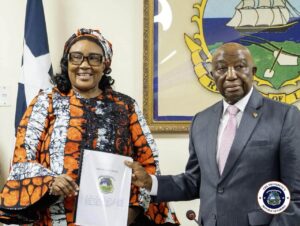
The event, attended by , Vice President ,Jeremiah Kpan Koung, cabinet officials, lawmakers, diplomats, development partners, and hundreds of civil servants, highlighted Liberia’s growing commitment to decentralization, public sector modernization, and citizen-centered governance.
Delivering the keynote historical reflection, Dr. Josiah F. Joekai described the decision to host the celebration in Nimba as “a practical demonstration” of President Boakai’s decentralization policy, emphasizing that government services must no longer remain concentrated in Montserrado County.
“This is more than symbolism; it is a clear signal that governance must reach every Liberian in every county, district, and community,” Dr. Joekai declared.
Public Service Day, observed annually on June 23, traces its roots to the First Pan-African Conference of Ministers Responsible for Public and Civil Service held in Tangier, Morocco, in 1994.
The conference established the day to recognize professionalism, ethical leadership, and excellence in governance.
Its significance expanded globally in 2002 when the United Nations formally adopted June 23 as International Public Service Day through Resolution 57/277.
Across Africa, the day has become an important platform for promoting accountability, innovation, and institutional efficiency in government.
For Liberia, this year’s celebration comes at a critical time.
According to the latest Civil Service Agency (CSA) records, the country’s public workforce now stands at over 63,000 employees, up from approximately 60,900 in 2024, reflecting expanded institutional growth and reforms aimed at payroll integrity, human resource modernization, and performance accountability.
The celebration also carries profound historical meaning for Nimba County itself.
Established on July 26, 1964, during the administration of former Liberian President , William V.S Tubman, Nimba was created as part of a national decentralization policy alongside Bong, Lofa, and Grand Gedeh Counties.
Today, with a population of 621,841 according to Liberia’s 2022 National Population and Housing Census, Nimba remains the country’s second-most populous county after Montserrado.
Beyond demographics, Nimba has long played a strategic role in Liberia’s economic development.
Its rich iron ore reserves, particularly in Yekepa, helped position Liberia among Africa’s top mineral exporters during the 1960s and 1970s, contributing significantly to national GDP and export earnings.
Sanniquellie itself occupies a revered place in African diplomatic history.
In 1959, the city hosted the historic Sanniquellie Conference, where President Tubman met with Ahmed Sékou Touré of Guinea and Prime Minister (later President) Kwame Nkrumah of Ghana and a meeting widely recognized as laying the groundwork for the creation of the , then the Organization of African Unity, in 1963.
Dr. Joekai used the occasion to highlight significant progress under President Boakai’s decentralization program.
He revealed that the CSA has successfully renovated and dedicated a regional office in Tubmanburg, Bomi County, now serving Bomi, Grand Cape Mount, and Gbarpolu Counties.
Additional regional expansion projects are underway in Zwedru, Grand Gedeh County, Gbarnga, Bong County, and Buchanan, Grand Bassa County.
The Gbarnga regional headquarters, once completed, will serve Bong, Nimba, and Lofa Counties dramatically reducing the burden on civil servants who previously had to travel to Monrovia for administrative services.
“These developments represent a fundamental shift in public administration,” Joekai said.
“Liberia’s decentralization agenda is no longer theoretical, it is becoming visible across the country” Dr.Joekai re-emphasized.
Liberia’s public sector reform remains central to the Boakai administration’s broader ARREST Agenda for Inclusive Development, which prioritizes governance, accountability, and institutional effectiveness.
The government has also pledged stronger investments in digital payroll systems, professional training, and improved service delivery mechanisms.
This year’s continental theme—“Enhancing Public Service Institutions and Empowering Multi-Stakeholder Partnerships to Achieve Universal Water Availability and Safe Sanitation by 2063” aligns with Africa’s Agenda 2063, which seeks to expand access to clean water and sanitation for over 1.4 billion Africans by mid-century.
In Liberia, where access to safe drinking water remains below 75 percent in many rural communities and sanitation coverage remains a major development challenge, officials say public service reform will be key to addressing these gaps.
As the ceremony concluded, Dr. Joekai praised Liberia’s public servants from teachers and health workers to security personnel, engineers, and agricultural officers calling them “the backbone of national transformation.”
With chants of President Boakai’s national call to “Think Liberia, Love Liberia, and Build Liberia,” the gathering ended with renewed calls for accountability, professionalism, and inclusive development.
For many observers, the significance of Public Service Day 2026 extends beyond ceremony, it marks a visible shift in how Liberia is redefining governance: from centralized administration to a people-focused model aimed at reaching every corner of the Republic.


